AMAT APPLIED MATERIALS 0100-20173 Stepper Controller Vme Pcb Card
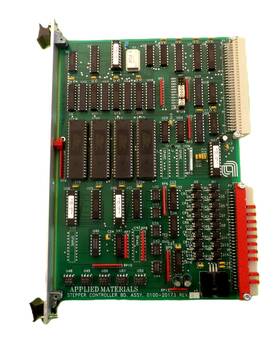
( Brand: Amat Applied Materials ), ( Manufacturer Part Number: 0100-20173 ), ( Part Type: Controller Card ), ( Category: Semiconductor Tools Systems And Components )
Review AMAT APPLIED MATERIALS Stepper Controller Vme Pcb Card Working
The **AMAT Applied 0100-20173 Stepper Controller VME PCB Card** is a high-performance, modular motion control solution designed for integration into VMEbus-based systems, offering precise and reliable stepper motor control for industrial automation, scientific instrumentation, and advanced manufacturing applications. This compact yet robust VME-compatible card features a sophisticated digital signal processing architecture, enabling seamless communication with a wide range of stepper motors through its versatile interface options, including parallel and serial handshaking protocols. Engineered for demanding environments, the 0100-20173 leverages advanced microcontroller technology to deliver real-time motion control with sub-microsecond resolution, ensuring smooth acceleration, deceleration, and positioning accuracy critical for high-speed applications. Its robust design incorporates high-speed digital I/O channels, programmable pulse outputs, and configurable limit switches, allowing for flexible integration into complex motion control systems. The card s VMEbus interface adheres to strict industry standards, ensuring compatibility with a broad spectrum of VME-compatible backplanes and host systems, while its compact form factor optimizes space utilization in cramped control cabinets. Ideal for applications requiring precise motion control such as CNC machining, robotics, semiconductor manufacturing, and automated test equipment, the 0100-20173 combines reliability, flexibility, and high performance to meet the rigorous demands of modern industrial automation. Whether deployed in a laboratory setting for scientific research or in a high-volume production line for manufacturing, this stepper controller card delivers the precision and responsiveness needed to enhance operational efficiency and productivity.
### **Pros and Cons of buying a AMAT Applied 0100-20173 Stepper Controller (VME PCB Card)**
#### **Pros:**1. **Compatibility with VMEbus Systems** The card is designed for integration into VME-based industrial automation, control systems, or scientific instrumentation, making it suitable for legacy or specialized setups where VME is still in use.
2. **High-Performance Stepper Motor Control** The controller is capable of driving stepper motors with precise positioning, which is essential for applications requiring accurate motion control, such as CNC machines, robotics, or automated testing equipment.
3. **Programmable and Flexible** The VME interface allows for integration with host systems (e.g., computers, PLCs, or FPGAs) for real-time control, enabling custom firmware or software-based motion profiles.
4. **Potential for Retrofitting** If you have existing VME-based hardware, this card can extend functionality without requiring a full system upgrade, which may be cost-effective for maintenance or expansion.
5. **Industrial-Grade Build** As an AMAT (Applied Motion Products) component, it likely adheres to industrial standards for reliability, durability, and environmental resistance (e.g., temperature, EMI shielding).
6. **Access to Technical Support & Documentation** AMAT (now part of **Applied Motion Products**, a subsidiary of **Baldor-Reliance**) provides documentation, firmware updates, and support, which can be valuable for troubleshooting or optimization.
7. **Compatibility with Older Systems** If you re working with legacy equipment that relies on VME, this card may be a necessary component for continued operation or modernization efforts.
---
#### **Cons:**1. **Outdated Interface (VMEbus)** VMEbus is an older standard (dating back to the 1980s) and is no longer widely used in modern systems. Finding compatible backplanes, power supplies, or host systems may be difficult, increasing maintenance costs.
2. **Limited Availability of Parts** As VME-based hardware becomes obsolete, sourcing replacement parts, firmware, or technical support may be challenging. The card may no longer be actively supported by the manufacturer.
3. **Higher Cost Relative to Modern Alternatives** Modern motion controllers (e.g., Ethernet/IP, USB, or PCIe-based) are often more affordable, feature-rich, and easier to integrate. A VME-based solution may require additional adapters or interfaces to connect to newer systems.
4. **Complex Integration** VME systems typically require specialized knowledge for setup, programming, and troubleshooting. If your team lacks expertise in VMEbus, implementation may be time-consuming and costly.
5. **No Native Networking or Remote Control** Unlike modern controllers with built-in Ethernet or USB, this card relies on the VME host for communication. Remote monitoring or control without physical access to the VME rack may be impractical.
6. **Potential for Obsolescence Risks** If the application can be migrated to a more modern interface (e.g., PCIe, CompactPCI, or even a standalone USB/RS-485 controller), the VME card may become a bottleneck or unnecessary expense.
7. **Limited Scalability** Adding more axes or advanced features (e.g., servo control, closed-loop feedback) may require additional VME slots or external interfaces, complicating the system architecture.
8. **No Built-in Safety Features** Modern controllers often include safety certifications (e.g., SIL, ISO 13849) or emergency stop integration. A VME-based solution may lack these features unless manually implemented.
---
### **Ending Conclusion:**The **AMAT Applied 0100-20173 Stepper Controller (VME PCB Card)** is a **specialized, high-performance motion control solution** best suited for **legacy VME-based systems** where no modern alternatives exist. It excels in **precision stepper motor control** and **integration with older industrial setups**, but its **obsolete interface, limited availability, and high integration complexity** make it a **poor choice for new projects** unless absolutely necessary.
If your application **requires VME compatibility** and you have no alternative, this card may be a viable (though aging) option. However, if possible, **evaluating modern motion controllers** (e.g., **Ethernet-based, PCIe, or standalone USB/RS-485 devices**) would likely offer **better long-term reliability, cost efficiency, and scalability**.
---
### **Recommendation:** - **Buy if:**- You are maintaining or upgrading a **legacy VME-based system** where this card is the only available solution.
- Your team has **experience with VMEbus** and can justify the long-term maintenance costs.
- No modern replacement exists for your specific application, and the card s performance meets critical requirements.
- **Avoid if:**- You are starting a **new project** modern interfaces (Ethernet, USB, or PCIe) are far more practical.
- You lack **VME expertise** integration may be too complex or costly.
- The card s **obsolete nature** could lead to **future compatibility issues** with other system components.
- A **less expensive, more scalable alternative** (e.g., a standalone stepper driver with Ethernet control) could achieve the same goal.
**Alternative Approach:**If possible, **assess whether the system can be migrated to a modern interface** (e.g., via a VME-to-Ethernet bridge or a new motion controller). This would reduce long-term risks and improve flexibility. If migration isn t feasible, proceed with caution, ensuring you have **backup parts, documentation, and support channels** in place.
Details:
Part No: 0100-20173. Made in the USA This is used working surplus. Sale Details. AMAT Applied Materials 0100-20173 Stepper Controller VME PCB Card Working.
Estimated Packed Shipping Dimensions: L x W12 5 lbs. Serial numbers or country of manufacture may vary. Only items pictured are included: If a part is not pictured, or mentioned above, then it included in the sale. Item condition: Working, 90 Day Warranty.
The physical condition is good, but there are signs of previous use and handling. Pictured test equipment is not included or available for sale.
part #: 010020173 prices
- $1204.26-$6063.75
specifications pcbemdev:
- brand: Amat Applied Materials
- mpn: 0100-20173
- part type: Controller Card
- category: Semiconductor Tools Systems And Components
payments pcbemdev:
- credit card: Mastercard
- wallet: Google-pay
- other
returns pcbemdev:
- time: 60 Days
- method: Money back
- paid by: Buyer
- policy: Returns Accepted
general pcbemdev:
- Electronic Components Semiconductors > Circuit Boards Prototyping > Printed Circuit Boards PCBs
- condition: Used
shipping pcbemdev:
- service: FedEx Ground / FedEx Home Delivery
- carrier: FedEx
- class: Standard
- transit: 4-7 Days
- type: Calculated
- cost: $0.00
seller pcbemdev:
- city: Albuquerque, New Mexico
- # reviews: 10396
- rating: 99.7%
offer pcbemdev:
- started: April 17, 2026
- sold: 0
- options: Ship-to-home
- best offers: True
- quantity: 6
- availability: In Stock
Amat Applied Materials 0100-20173 Is Similar To:
- 0100-20453 0190-00371 Amat Devicenet I O Pcb Cube I O Dip180 Centura Hdp-cvd (28.2% similar) What you see in the pictures what you get genuine Applied Materials device net digital I o input output pcb assay Amat P/N 20453WITH device net cube DIP180 module, val p4 3410 06FOR century GDP CVS 300MM system fast safe free domestic sharpening 2B40530 Amat device net I o pcb cube DIP180 century ...(June 10th, 2016)
- 10070062 Applied Materials Rev Controller Board Mei Amat Used (55.2% similar) Orders can be expedited upon request. If there is an issue with the item, please by e-mail for resolution. Local pick-up is an option. Note: listing picture is the exact part or identical. Look under surplus parts: stores...(October 30th, 2019)
- Applied Materials 0100-09134 Amat Dio Fuse Pcb Board Reseller Lot Of 2 As-is (53.7% similar) These units are also missing fuses. Sold as-is this Amat Applied Materials 0100-09134 Dior fuse pcb board is used untested surplus and being sold as-is. Part no: 0100-09134. Only items pictured are included: if a part is not pictured, or mentioned above, then it included in the sale. The physical ...(September 1st, 2023)
- Applied Materials 0190-09957 Amat Mainframe Interface Working Surplus (57.7% similar) Sale details. Amat Applied Materials 0190-09957 mainframe interface working surplus. 0190-10208THIS Amat Applied Materials 0190-01971 analog power supply is used working surplus. Pictured test equipment is not included or available for sale. Serial numbers or country of manufacture may vary. Item ...(September 26th, 2023)
- Applied Materials 0100-02464 Amat Gas Panel Distribution Pcb Working (61% similar) The physical condition is good, but there are signs of previous use and handling. Made in the usages Amat Applied Materials 0100-02464 gas panel distribution is used working surplus. Sale details. Model no: gas panel distribution. Serial numbers or country of manufacture may vary. Amat Applied ...(September 27th, 2023)
- Mks Instruments As01396 Analog I o Vme Pcb Cdn396r Amat 0190-24116 Working (35.4% similar) Only items pictured are included: if a part is not pictured, or mentioned above, then it included in the sale. Serial numbers or country of manufacture may vary. The physical condition is good, but there are signs of previous use and handling. Model no: CDN396R. Amat Applied Materials part no: 0190-...(September 28th, 2023)
- Ge Fanuc 0190-32401 Vmicpci-7326 Sbc Single Board Computer Pcb Card Amat Working (41.8% similar) Ge fang VMICPCI-7326 ABC single board computer pcb card Amat 0190-32401 working. Ge fang part no: 35 00. Pictured test equipment is not included or available for sale. Only items pictured are included: if a part is not pictured, or mentioned above, then it included in the sale. Serial numbers or ...(November 9th, 2023)
- Applied Materials 0130-00537 Amat Sd Stepper Interface Lot Of 2 Working Surplus (63.2% similar) Amat Applied Materials 0130-00537 SD stepper interface lot of 2 working surplus. Pictured test equipment is not included or available for sale. Only items pictured are included: if a part is not pictured, or mentioned above, then it included in the sale. Part no: 0130-00537. The physical condition ...(December 18th, 2023)
- Amat Applied Materials 0100-02813 Signal Conditioning Board Pcb Working Surplus (68.4% similar) Only items pictured are included: if a part is not pictured, or mentioned above, then it included in the sale. The physical condition is good, but there are signs of previous use and handling. Amat Applied Materials 0100-02813 signal conditioning board pcb working surplus. Item condition: used ...(January 12th, 2024)
- Amat Applied Materials 0100-02157 Contactor Control Endura 300mm Working Spare (68.9% similar) Part no: 0100-02157. Item condition: used working, 90 day warranty. Contractor control endure 300MMTHIS Amat Applied Materials 0100-02157 contractor control is used working surplus. Pictured test equipment is not included or available for sale. Serial numbers or country of manufacture may vary. Amat...(January 15th, 2024)
- Dip 15049105 Devicenet I o Pcb Card Cdn491 010-010 Amat 0660-01879 Mks Working (37.1% similar) Sale details. Dip 15049105 device net i/o pcb card CDN491 010-010 Amat 0660-01879 mks working. Amat Applied Materials part no: 0660-01879THIS dip 15049105 device net i/o pcb card is used working surplus. Pictured test equipment is not included or available for sale. The physical condition is good, ...(January 19th, 2024)