CEI Pcb Control Panel Board Display PIC1655A-078 7-SEGMENT
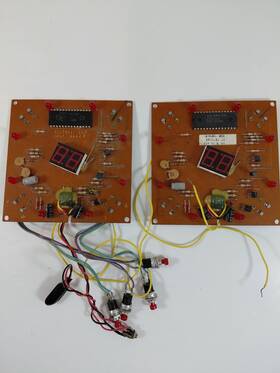
( Brand: Cei ), ( Manufacturer Part Number: 1655A-078 ), ( Part Type: Control Display Panel Board ), ( Country Of Origin: Taiwan ), ( Mexico: Assembly ), ( Item Height: 15mm ), ( Item Length: 100mm ), ( Material: Fr-4 ), ( Mounting Style: Chassis Mount, Through-hole ), ( Operating Voltage: 9v Dc ), ( Pcb Type: Single-sided, Populated Board ), ( Unit Type: Boards )
Review CEI Vintage Pcb Control Panel Board Display
The **1655A-078 PCB Control Panel Board with 7-Segment Display** is a precision-engineered modular interface designed to enhance automation, industrial control, and custom instrumentation systems with intuitive human-machine interaction. This compact yet robust control panel board integrates a high-precision **7-segment LED display** (likely a 4-digit or 7-digit configuration, depending on the specific variant) paired with a **customizable front-panel PCB layout**, allowing seamless integration into machinery, test equipment, or process control applications. Engineered for durability, the board features a **high-quality printed circuit board (PCB)** with soldered through-hole or surface-mount components, ensuring reliable signal routing and minimal electrical noise for accurate readings. The 7-segment display provides clear, backlit numerical output, ideal for real-time monitoring of voltage, current, temperature, or other critical parameters, while its modular design allows for easy mounting in enclosures or direct panel integration via DIN rail or panel cutouts. Compatible with a wide range of microcontrollers, PLCs, or standalone logic circuits, this board supports flexible programming interfaces such as **RS-232, RS-485, or direct GPIO connections**, making it adaptable for both analog and digital control systems. Whether used in educational prototyping, industrial automation, or custom instrumentation projects, the **1655A-078** delivers a balance of functionality, precision, and ease of integration, empowering engineers and technicians to build responsive and user-friendly control interfaces with minimal additional hardware. Its compact footprint and scalable design further reduce installation complexity, making it a versatile choice for applications requiring both functionality and aesthetic integration.
### Overview of the PIC16F55A-078 PCB Control Panel with 7-Segment Display
The **PIC16F55A-078** is a microcontroller-based development board featuring a 7-segment display, often used for learning embedded systems, digital electronics, or prototyping small electronic projects. Below is a detailed analysis of its pros and cons, followed by a conclusion and recommendation.
---
### **Pros**
1. **Educational Value**
The board is ideal for beginners learning microcontroller programming (e.g., C or assembly for PIC microcontrollers). It introduces fundamental concepts like GPIO control, digital output, and basic interfacing with displays.
2. **Affordability**
Compared to more advanced development boards (e.g., Arduino or Raspberry Pi), this board is relatively inexpensive, making it accessible for hobbyists and students on a budget.
3. **Compact and Simple Design**
The PCB is small and straightforward, focusing on core functionality without unnecessary complexity. This makes it easier to understand and modify for specific projects.
4. **7-Segment Display Integration**
The inclusion of a 7-segment display allows users to practice driving LEDs, decoding BCD (Binary-Coded Decimal) values, and implementing basic arithmetic or timing functions. This is a common requirement in digital clock, counter, or calculator projects.
5. **PIC Microcontroller Flexibility**
The PIC16F55A is a versatile 8-bit microcontroller with a small footprint, making it suitable for low-power applications. It supports in-circuit serial programming (ICSP), allowing easy reprogramming without external tools in some cases.
6. **Open-Source and Customizable**
Many users share schematics, code examples, and modifications online, enabling customization for specific needs (e.g., adding buttons, sensors, or additional displays).
7. **Low Power Consumption**
Suitable for battery-powered projects due to the PIC16F55A s efficient operation, though actual power usage depends on the application.
8. **No Complex Peripherals**
The lack of advanced features (e.g., no built-in Wi-Fi, high-speed ADC, or motor drivers) forces users to focus on fundamentals rather than being overwhelmed by complexity.
---
### **Cons**
1. **Limited Documentation**
Unlike popular boards (e.g., Arduino Uno), this specific board may lack comprehensive user manuals, tutorials, or community support. Users often rely on generic PIC16F55A resources, which may not address the board s unique layout or components.
2. **Basic Functionality**
The board is not designed for advanced applications. It lacks features like:- Analog-to-digital converters (ADCs) with high resolution (the PIC16F55A has only 8-bit ADC).
- Communication interfaces (e.g., UART, SPI, or I2C are possible but require manual wiring).
- Built-in oscillators or voltage regulators (users may need external components).
- Protective features (e.g., no reverse polarity protection or overvoltage safeguards).
3. **No Pre-Programmed Firmware**
Unlike Arduino boards, this board does not come with bootloader software or an IDE tailored to the PIC microcontroller. Users must manually program the chip using tools like MPLAB X, which has a steeper learning curve.
4. **Physical Limitations**
The PCB may not accommodate additional components easily due to its small size. Expanding functionality (e.g., adding buttons or sensors) could require soldering or external breakout boards.
5. **Dependence on External Tools**
Programming the PIC16F55A typically requires:- A PICKit or similar programmer (e.g., ICD2) for flashing the microcontroller.
- A breadboard or additional wiring for prototyping if the board lacks headers or connectors.
- Basic soldering skills if modifying the PCB.
6. **No Built-in Power Regulation**
The board may not include a stable voltage regulator, requiring users to provide a clean 5V supply or use external components (e.g., a 7805 regulator).
7. **Potential Quality Issues**
Since this is a generic or third-party board, there may be inconsistencies in component quality, soldering, or PCB design. Users should inspect the board for defects before purchase.
8. **Limited Scalability**
For projects requiring more I/O, memory, or processing power, the PIC16F55A s 20-pin package and 1KB program memory are restrictive. Users may outgrow the board quickly for complex applications.
---
### **Conclusion**
The **PIC16F55A-078 PCB control panel with a 7-segment display** is a practical choice for **beginners** or **educational purposes**, particularly for those interested in learning microcontroller basics, digital interfacing, or simple display-driven projects. Its affordability, simplicity, and focus on core concepts make it a valuable tool for foundational learning.
However, it is **not suitable** for advanced projects, professional development, or applications requiring robust peripherals, high-speed communication, or extensive I/O. Users should be prepared for manual programming, limited documentation, and potential challenges in expanding functionality.
---
### **Recommendation**
1. **For Beginners or Students:** Purchase this board if your goal is to:- Learn PIC microcontroller programming (C or assembly).
- Experiment with basic digital outputs and 7-segment displays.
- Build simple projects like digital clocks, counters, or calculators.
*Tip:* Pair it with a PICKit programmer and MPLAB X IDE for a complete setup.
2. **For Advanced Users or Professionals:** Consider alternative boards with more features, such as:- **Arduino Uno** (easy programming, extensive libraries, and community support).
- **PIC18F or PIC32** development boards (more memory, peripherals, and scalability).
- **Raspberry Pi Pico** (if you prefer ARM-based microcontrollers with USB support).
3. **For Prototyping with Limited Budget:** If you need a balance between simplicity and functionality, look for boards with:- Built-in USB programming (e.g., PIC18F25K22 with PICKit3).
- Additional I/O headers or breakout pins.
- Pre-loaded examples or tutorials.
4. **Before Purchase:**- Verify the board s specifications (e.g., voltage requirements, pinout, and included components).
- Check seller reviews for quality and compatibility with the PIC16F55A.
- Ensure you have access to a programmer (e.g., PICKit 2 or ICD 3) and development software.
---
**Final Verdict:** This board is a **great starting point** for microcontroller learning but should not be the sole tool for long-term or complex projects. Supplement it with additional resources (e.g., books, online courses) to maximize its educational value.
Details:
These boards appear to be part of a control panel or display unit, featuring 7-SEGMENT LED display, multiple red indicator Leds, and various discrete components such as resistors, capacitors, diodes. The boards are populated with through-hole components and feature a brown FR-4 substrate on the component side green solder mask trace. This was found in a home clean out and is untested. This listing includes two vintage CEI brand printed circuit boards CBS, identified by the PIC 1655A-078 IC, likely manufactured in Taiwan.
The boards are designed for chassis mounting via four corner holes. Please examine all photos carefully to assess the condition and included components. They are offered as-is for collectors, hobbyists, or parts/repair of vintage electronic equipment. Each board measures approximately 100mm x and includes pre-wired push-button switches a 9V battery snap connector, suggesting low- voltage DC operation.
part #: 1655a078 price
- $24.60
specifications pcbemdev:
- brand: Cei
- mpn: 1655a-078
- part type: Control Display Panel Board
- country of origin: Taiwan
- mexico: Assembly
- item height: 15mm
- item length: 100mm
- material: Fr-4
- mounting style: Chassis Mount, Through-hole
- operating voltage: 9v Dc
- pcb type: Single-sided, Populated Board
- unit type: Boards
general pcbemdev:
- condition: For parts or not working
- Electronic Components Semiconductors > Circuit Boards Prototyping > Printed Circuit Boards PCBs
payments pcbemdev:
- wallet: Apple-pay
- credit card: Diners-club
- other
returns pcbemdev:
- time: 30 Days
- paid by: Seller
- method: Money back
- policy: Returns Accepted
shipping pcbemdev:
- service: USPS Ground Advantage
- class: Standard
- carrier: USPS
- cost: $5.52
- type: Calculated
- transit: 3-7 Days
seller pcbemdev:
- city: North Royalton, Ohio
- rating: 100.0%
- # reviews: 2502
offer pcbemdev:
- best offers: True
- options: Ship-to-home
- quantity: 1
- sold: 0
- availability: In Stock
- started: February 2, 2026