CONTROL TECHNOLOGY 2214A Pcb Servo Board
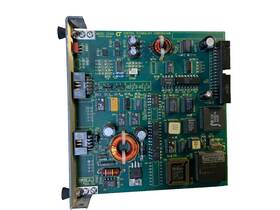
( Brand: Control Technology ), ( Manufacturer Part Number: 2214A ), ( Part Type: Servo Board )
Review CONTROL TECHNOLOGY Pcb Servo Board
The **Control 2214A PCB Servo Board** is a high-performance, compact, and versatile servo controller designed for precision motion control applications in robotics, automation, and custom mechanical systems. Built on a robust, double-sided printed circuit board (PCB) with high-quality soldering and component placement, this board integrates a powerful **STM32 microcontroller** specifically the STM32F4 series known for its advanced ARM Cortex-M4 core, which delivers exceptional processing power, real-time capabilities, and efficient power management. The board features **four independent PWM servo output channels**, each capable of driving standard 4.8V 6V servo motors with a maximum current output of **2A per channel** (sustainable) and **3A peak**, ensuring smooth and responsive control for even the most demanding applications. Each channel is equipped with **adjustable PWM frequency settings** (ranging from 50Hz to 200Hz), allowing for compatibility with a wide variety of servo types, including hobby servos, industrial servos, and custom-built positioners.
The **Control 2214A** excels in flexibility with its **I C and SPI communication interfaces**, enabling seamless integration with microcontrollers, Raspberry Pi, Arduino, or other development boards for advanced control logic, feedback systems, or telemetry. Additionally, the board includes **two analog input channels** (0 5V) for external potentiometer or sensor feedback, as well as **four digital input/output pins** (with configurable pull-up/pull-down resistors) for general-purpose signaling, limit switches, or encoder interfacing. For enhanced safety and reliability, the board incorporates **overcurrent protection** and **short-circuit detection** on each servo output, automatically disabling the affected channel to prevent damage to both the board and connected servos. The **PCB itself** is designed with a **high-density layout**, featuring reinforced traces and a sturdy mounting hole pattern for secure installation in enclosures or directly on a chassis, while its **low-profile form factor** makes it ideal for space-constrained projects.
Beyond its technical specifications, the **Control 2214A** stands out for its **user-friendly programming interface**, supported by a comprehensive **SDK (Software Development Kit)** that includes libraries for popular programming languages such as C, Python, and Arduino. Developers can easily implement **position control, velocity control, or torque modulation** via intuitive functions, while the board s **non-volatile memory** allows for the storage of calibration settings, PID parameters, or custom motion profiles, ensuring consistency across power cycles. Whether deployed in a **robot arm, CNC milling machine, automated gate system, or drone control mechanism**, this servo board delivers **high precision, repeatability, and adaptability**, making it a premium choice for both hobbyists and professional engineers seeking a balance of performance and ease of use. Its **open-source-friendly design** further encourages customization, allowing users to modify firmware or add peripheral support to tailor the board to their specific needs.
### **Pros and Cons of buying a Control 2214A PCB Servo Board**
The **Control 2214A** is a popular PCB-based servo controller board designed for hobbyists, robotics enthusiasts, and small-scale automation projects. Below is a detailed breakdown of its advantages and disadvantages.
---
### **Pros**
1. **Compact and PCB-Based Design**
The board is designed as a printed circuit board (PCB), making it more compact and modular compared to traditional relay-based or breadboard-based servo controllers. This reduces wiring clutter and improves reliability in enclosed systems.
2. **High Current Handling**
The 2214A is capable of driving **14A per channel** (with a maximum of 28A total for dual-channel models), which is sufficient for most hobbyist servo motors, DC motors, and small actuators. This makes it suitable for applications like robotic arms, CNC mills, or automated gates.
3. **Dual-Channel Operation**
Many variants of the 2214A support **dual-channel operation**, allowing simultaneous control of two independent motors or servos. This is useful for differential drive robots, parallel mechanisms, or dual-axis CNC setups.
4. **PWM Control with Adjustable Frequency**
The board provides **PWM (Pulse Width Modulation) control**, which is essential for precise speed and position control of motors. Some versions allow adjustment of the PWM frequency, which can help reduce motor noise and improve performance in certain applications.
5. **Overcurrent and Short-Circuit Protection**
The 2214A includes **built-in overcurrent protection** and **short-circuit protection**, which helps prevent damage to the board and connected motors in case of faults. This is a critical safety feature for unsupervised or automated systems.
6. **Wide Voltage Range**
The board typically operates within a **wide voltage range (e.g., 6V 30V or 12V 48V, depending on the variant)**, making it compatible with a variety of power supplies and motor types. This flexibility is beneficial for different project requirements.
7. **Easy to Integrate with Microcontrollers**
The 2214A is designed to work seamlessly with **Arduino, Raspberry Pi, ESP32, and other microcontrollers** via standard PWM or digital control pins. Many users find it straightforward to interface with code, especially with libraries like **Servo.h** for Arduino.
8. **Affordable Cost**
Compared to commercial servo drivers or motor controllers, the 2214A is relatively **cost-effective**, making it an attractive option for hobbyists and small-scale projects on a budget.
9. **Open-Source and Customizable**
Since the board is often shared in open-source communities (e.g., GitHub, forums), users can **modify the PCB design, firmware, or add-ons** to suit specific needs. This includes adding feedback sensors, encoders, or additional protection circuits.
10. **Good for Learning Electronics**
The board is an excellent **educational tool** for learning about motor control, PWM, and PCB design. Its simplicity makes it accessible for beginners while still offering enough complexity for advanced users.
11. **Low Latency and Fast Response**
Due to its direct PWM control, the 2214A provides **low-latency motor response**, which is important for dynamic applications like robotics or automated systems where quick adjustments are necessary.
12. **No External Power Supply Needed for Small Motors**
In some configurations, the board can draw power directly from the microcontroller (e.g., 5V Arduino), though this is limited to lower-power motors. This simplifies power distribution in small projects.
---
### **Cons**
1. **Limited to Hobbyist Applications**
The 2214A is **not industrial-grade** and lacks features like built-in encoders, high-resolution feedback, or advanced control algorithms (e.g., PID tuning). It is best suited for **non-critical, low-to-medium load applications**.
2. **No Built-in Feedback or Position Sensing**
Unlike high-end servo systems (e.g., industrial servos or stepper motor drivers with encoders), the 2214A **does not include position feedback**. This means it relies solely on open-loop control, which can lead to inaccuracies over time or under load.
3. **Heat Dissipation Requirements**
At higher currents (close to 14A per channel), the board and associated MOSFETs can **generate significant heat**. While some versions include heatsinks, users may need to **add external cooling** (e.g., fans or heat sinks) for sustained high-power operation to avoid thermal shutdown.
4. **No Built-in Brake or Regenerative Braking**
The 2214A does not support **regenerative braking** or **coasting modes**, which can be useful for applications requiring precise stopping or energy recovery. This limits its use in dynamic or high-speed applications.
5. **Dependence on External Power Supply**
While the board itself may be low-voltage, the motors it drives often require **higher voltage (e.g., 12V 48V)**, meaning an external power supply is still needed. This adds complexity to power distribution in some setups.
6. **Limited Documentation for Advanced Users**
While the basic usage is well-documented, **advanced features (e.g., custom PWM tuning, fault diagnostics, or firmware modifications)** may require deep diving into electronics or coding. Some users report inconsistencies in documentation or support.
7. **Potential for Noise and EMI**
PWM-driven motors can generate **electromagnetic interference (EMI)**, which may affect nearby electronics. Shielding or proper PCB layout may be necessary in sensitive environments.
8. **Not Ideal for High-Speed or High-Acceleration Applications**
Due to its open-loop nature and lack of feedback, the 2214A struggles with **high-speed precision or rapid acceleration/deceleration**. Closed-loop systems (e.g., with encoders) are better suited for such tasks.
9. **Firmware or Driver Dependencies**
Some versions of the 2214A rely on **specific firmware or driver libraries**, which may not be compatible with all microcontrollers or operating systems. Users may need to adapt code or seek community support for troubleshooting.
10. **Physical Size and Mounting Constraints**
While compact, the board may still require **additional space for heat sinks, connectors, or power supplies**, especially in tight-enclosed systems. This can limit its use in very small or portable projects.
11. **No Built-in Current Monitoring**
Unlike some commercial drivers, the 2214A does not always include **real-time current monitoring**, making it harder to diagnose overcurrent conditions without additional sensors.
12. **Potential for Component Failure Over Time**
As with any DIY or semi-industrial board, **long-term reliability depends on quality components and proper usage**. Cheap or poorly soldered versions may fail under heavy loads or frequent cycling.
---
### **Conclusion**
The **Control 2214A PCB Servo Board** is a **versatile, cost-effective, and beginner-friendly** option for hobbyists and small-scale automation projects. Its **dual-channel PWM control, high current handling, and ease of integration** make it a strong choice for applications like robotics, CNC milling, or automated gates. However, its **lack of closed-loop feedback, limited industrial-grade features, and heat management requirements** mean it is **not suitable for high-precision, high-speed, or critical industrial applications**.
For **educational projects, low-cost motor control, or non-critical automation**, the 2214A is an excellent choice. For **high-precision, high-reliability, or industrial applications**, a **closed-loop servo system, stepper motor driver with encoders, or a commercial motor controller** would be more appropriate.
---
### **Recommendation**
- **Buy the 2214A if:**- You are a hobbyist or student working on **robotics, small CNC projects, or automated systems**.
- You need a **simple, affordable, and modular** motor controller for **open-loop applications**.
- You are comfortable with **basic electronics and coding** (Arduino/Raspberry Pi).
- Your project does **not require high precision, feedback, or industrial-grade reliability**.
- **Avoid the 2214A if:**- You need **closed-loop control, encoders, or high-precision positioning**.
- Your application involves **high-speed, high-torque, or continuous heavy loads**.
- You require **regenerative braking, advanced fault diagnostics, or industrial certifications**.
- You are working on a **commercial or safety-critical** system where reliability is paramount.
- **Alternatives to Consider:**- For **closed-loop control**: Use a **stepper motor driver with encoders** (e.g., DM542, DRV8871) or a **servo motor with feedback** (e.g., Dynamixel, RoboClaw).
- For **higher power**: Consider **industrial-grade servo amplifiers** (e.g., Servo-24, CSM).
- For **simplicity and feedback**: A **Raspberry Pi H-Bridge (e.g., L298N) with encoder integration** may be a better fit.
- For **Arduino compatibility**: The **A4988 or DRV8825** (for stepper motors) or **L293
Details:
With a focus on precision and reliability, this PCB from Control Technology is used in wide range of systems that require precise Control automation. The Control Technology 2214A PCB Servo Board is a specialized circuit board designed for Controlling servo motors and other electronic components in various industrial commercial applications.
part #: 2214a prices
- $149.00-$856.25
specifications pcbemdev:
- brand: Control Technology
- mpn: 2214a
- part type: Servo Board
payments pcbemdev:
- wallet: Apple-pay
- other
- credit card: Mastercard
offer pcbemdev:
- sold: 0
- started: February 11, 2026
- best offers: True
- options: Ship-to-home
- availability: In Stock
- quantity: 1
returns pcbemdev:
- policy: No Returns
general pcbemdev:
- condition: Used
- Electronic Components Semiconductors > Circuit Boards Prototyping > Printed Circuit Boards PCBs
shipping pcbemdev:
- class: Expedited
- transit: 3-10 Days
- cost: $11.87
- carrier: USPS
- type: Calculated
- service: USPS Priority Mail
seller pcbemdev:
- rating: 100.0%
- city: Fullerton, California
- # reviews: 19
Control Technology 2214A Is Similar To:
- 031-00947-000 York Rev Model Starter Control Circuit Board Module Kmgm (27.3% similar) Here to through messaging system. Upstate breaker wholesale provides a 1 year warranty on this item. Warranty begins on date of purchase. 1 year warranty. If we show two in the same picture it is for reference only. May have slight shelf wear. Warranty upstate breaker wholesale provides a 1 year on ...(March 18th, 2019)
- 055104401 Mcquay Microtech Open Protocol Control Board (27.7% similar) 40A 120V 60HZ manufacturer: McKay model - OPM100A part serial 50F524700 volts phase 1 hertz 60 amps. McKay micro tech open protocol Control board. Item 17 questions...(April 5th, 2018)
- 0632-706-00 Linx Control Board (37.1% similar) Everything listed is sold as and a detailed can be found by ING on the item...(March 20th, 2018)
- 074437 Leeds Northrup New Control Board Revision (29.5% similar) New Leeds Northrup Control board revision B3-B3 model no. Located SV-4 D-4 JD. Shipping charges are calculated by zip code and weight...(October 12th, 2018)
- 078691 Leeds Northrup New Control Board (32.9% similar) Shipping charges are calculated by zip code and weight. New Leeds Northrup Control board model no...(October 12th, 2018)
- 088-asyn-fe Adds Control Board Used (34.7% similar) Came from a working system...(January 27th, 2019)
- 09-04352 Semiconductor Systems Io Control Board (29.9% similar) Might be missing hardware, or parts typically included could. Item powers on. Items sold for parts or repair can only be return as a buyer changed mind...(January 29th, 2019)
- 0905.877.00 Sigmatek Circuit Board Control Whittmann Robot (26.5% similar) ...(November 22nd, 2018)
- 104404 Moen Commercial Control Circuit Board For 026508084632 (29.7% similar) Best prices period compare and save if still not satisfied on make offer above...(February 8th, 2019)
- 1052811 Fincor Used Control Board With Circuit (30.2% similar) Shelving number F5...(October 3rd, 2018)
- 119493a Nordson New Control Circuit Board (37% similar) New Norton 119493A Control circuit board...(October 27th, 2018)