CPC 237-4820 Keypad Pcb Panel Mount Rigid E2 2.10 3.3V FR-4
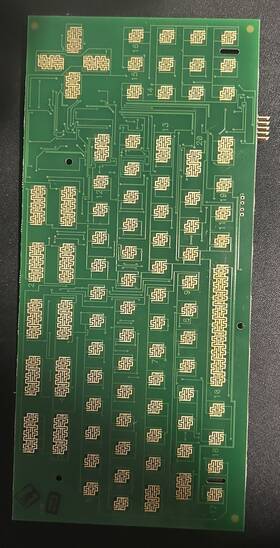
( Brand: Cpc ), ( Manufacturer Part Number: 237-4820 ), ( Part Type: Panel Mount ), ( Pcb Type: Rigid Pcb ), ( Series: E2 Keypad Rev 2.10 ), ( Operating Voltage: 3.3 V ), ( Item Height: 2.0 ), ( Material: Fr-4 ), ( Item Length: 2.10 )
Review CPC E2 Keypad Rev 2.10 Pcb 3.3v Panel Mount Rigid Fr-4
The **CPC 237-4820 E2 Keypad PCB (3.3V, Panel-Mount, Rigid FR-4)** is a high-performance, compact keypad module designed for embedded systems, industrial control panels, and custom human-machine interface (HMI) applications requiring precise input and robust durability. Engineered with a **rigid FR-4 substrate**, this keypad offers exceptional mechanical stability and resistance to environmental stressors, making it ideal for harsh operating conditions where reliability is paramount. The **E2 keypad variant** features a **2.10" (53.34mm) square form factor**, providing a balanced size that accommodates up to **12 programmable keys** in a grid layout, allowing for flexible customization to match specific application requirements whether for data entry, menu navigation, or control signal input.
Operating seamlessly within a **3.3V power supply range**, this keypad is optimized for low-power microcontroller systems, reducing overall system complexity and energy consumption while maintaining clear, debounced key signals. The **panel-mount design** ensures a clean, flush installation, minimizing clutter in enclosed or space-constrained environments, and its **rigid construction** eliminates flexing or signal interference that could arise from flexible substrates. Each key is designed with **high-contrast, durable membrane switches**, offering tactile feedback and long-term durability against repeated use, dust, and moisture critical for applications in automotive, medical, or industrial settings where reliability is non-negotiable.
The **CPC 237-4820** supports **matrix scanning**, enabling efficient key detection with minimal GPIO pins, which simplifies wiring and reduces board space. Its **programmable key assignments** allow developers to map inputs to custom functions, making it adaptable for everything from simple numeric keypads to complex command interfaces. Additionally, the keypad s **FR-4 material** ensures thermal stability and resistance to soldering heat, while its **surface-mount technology (SMT) or through-hole (TH) compatible design** (depending on variant) offers flexibility in assembly processes. Whether integrated into a custom control panel, a portable device, or an industrial automation system, this keypad delivers a **precise, durable, and low-power input solution** that enhances user interaction while maintaining system integrity under demanding conditions.
### **Pros and Cons of buying a CPC 237-4820 E2 Keypad (2.10" PCB, 3.3V, Panel-Mount, Rigid FR-4)**
#### **Pros:**1. **Compact and Space-Efficient Design** The 2.10" size makes it suitable for applications where space is limited, such as industrial control panels, embedded systems, or compact IoT devices.
2. **Panel-Mount Compatibility** The rigid FR-4 PCB and panel-mount design allow for easy integration into existing enclosures, reducing assembly complexity.
3. **3.3V Operation** Compatibility with 3.3V logic levels is beneficial for modern microcontrollers (e.g., ARM Cortex-M, ESP32, RP2040) and low-power applications, reducing the need for level-shifting circuits.
4. **Reliable Mechanical Construction** The rigid FR-4 PCB provides durability, making it resistant to flexing or damage during installation and use.
5. **Potential for Customization** Some keypad models in this series support programmable keys, allowing for flexible input configurations (e.g., numeric, alphanumeric, or function keys).
6. **Industrial-Grade Build** The E2 series is often designed for industrial or rugged environments, offering better longevity than consumer-grade alternatives.
7. **Easy Integration with Microcontrollers** Many keypads in this category use standard communication protocols (e.g., SPI, I2C, or direct GPIO) that are easy to interface with common development boards.
8. **Cost-Effective for Bulk Applications** If used in high-volume production, the per-unit cost may be justified by its reliability and compact form factor.
#### **Cons:**1. **Limited Key Customization** Unlike fully programmable keypads, this model may have fixed key assignments, restricting flexibility in user interface design.
2. **No Backlighting (Unless Specified Otherwise)** If backlit keys are required, this model may not include them, potentially requiring additional modifications or external lighting solutions.
3. **Potential for Limited Documentation** Some niche or older models may lack detailed datasheets or community support, making troubleshooting or integration more challenging.
4. **Dependence on Supplier Availability** As a specialized component, stock availability may be inconsistent, leading to delays in procurement.
5. **No Touchscreen Alternative** If a touch-sensitive interface is desired, this mechanical keypad is not suitable, requiring a separate touchscreen module.
6. **Possible Learning Curve for New Users** Developers unfamiliar with keypad interfacing (e.g., debouncing, scan matrix logic) may need additional time to implement correctly.
7. **Cost for Low-Volume Projects** For one-off or small-scale projects, the price per unit may be higher than off-the-shelf alternatives (e.g., Arduino-compatible keypads).
8. **No Built-In Encryption or Security Features** If the application requires secure input handling (e.g., PIN entry for sensitive systems), additional hardware or software measures will be necessary.
---
### **Conclusion**
The **CPC 237-4820 E2 keypad** is a **practical choice for applications requiring a compact, 3.3V-compatible, panel-mount keypad** in industrial or embedded systems. Its rigid construction and space efficiency make it ideal for environments where durability and integration are critical. However, its **fixed key layout, lack of backlighting (unless specified), and potential documentation gaps** may pose challenges depending on the use case.
If your project demands **flexibility in key assignments, backlit keys, or touch input**, alternative solutions (e.g., programmable keypads, touchscreens, or Arduino-compatible modules) might be more suitable. Conversely, if **cost-effective, low-power, and space-constrained input is the priority**, this keypad is a solid option provided you account for any integration complexities upfront.
---
### **Recommendation**
**Buy this keypad if:**- You need a **small, rugged, panel-mount keypad** for an industrial or embedded system.
- Your microcontroller operates at **3.3V** and requires a simple, reliable input method.
- You are working on a **high-volume project** where the per-unit cost is justified by long-term reliability.
- You can **design around its fixed key layout** or accept minimal customization.
**Avoid or consider alternatives if:**- You require **programmable keys, backlighting, or touch input**.
- Your project is **low-volume**, and a more flexible (but potentially pricier) keypad would be easier to integrate.
- You lack experience with **keypad interfacing** (e.g., debouncing, scan matrix logic), as this may require additional development effort.
- **Stock availability or documentation quality** is a concern, and you need immediate support.
**Alternative Considerations:**- For **programmable keys**, look into **I2C/SPI keypads** (e.g., Adafruit 16-Button Keypad).
- For **backlit or touch-sensitive input**, evaluate **capacitive touch keypads** or **LCD/touchscreen modules**.
- For **Arduino/Raspberry Pi compatibility**, pre-built modules (e.g., Seeed Studio Keypad Shield) may simplify integration.
Details:
CPC E2 Keypad Rev 2.10 PCB 237-4820 3.3V Panel Mount Rigid FR-4.
part #: 2374820 price
- $175.00
specifications pcbemdev:
- brand: Cpc
- mpn: 237-4820
- part type: Panel Mount
- pcb type: Rigid Pcb
- series: E2 Keypad Rev 2.10
- operating voltage: 3.3 V
- item height: 2.0
- material: Fr-4
- item length: 2.10
offer pcbemdev:
- availability: In Stock
- options: Ship-to-home
- quantity: 1
- sold: 0
- started: May 21, 2026
- best offers: True
payments pcbemdev:
- credit card: Diners-club
- other
- wallet: Apple-pay
general pcbemdev:
- condition: Used
- Electronic Components Semiconductors > Circuit Boards Prototyping > Printed Circuit Boards PCBs
returns pcbemdev:
- policy: No Returns
seller pcbemdev:
- rating: 100.0%
- city: Chester, Illinois
- # reviews: 2
shipping pcbemdev:
- type: Calculated
- class: Standard
- service: USPS Ground Advantage
- cost: $0.00
- transit: 5-11 Days
- carrier: USPS
Cpc 237-4820 Is Similar To:
- Tel Tokyo Electron 2980-092300-11 Chemical I o Pcb Tob1015 Cpc-t0015a-11 New (21.6% similar) Part no: 2980-092300-11. Tel Tokyo electron 2980-092300-11 chemical i/o pcb TOB1015 CPC-T0015A-11 new. Sale details. Serial numbers or country of manufacture may vary. Pictured test equipment is not included or available for sale. Model no: TOB1015. The physical condition is great. Only items ...(December 8th, 2023)
- Tel Tokyo Electron Cpc-t0001a-12 Chemical I o Board Pcb Tob1001 Working Surplus (26.8% similar) Pictured test equipment is not included or available for sale. Serial numbers or country of manufacture may vary. Model no: TOB1001. Item condition: working, 90 day warranty. Tel Tokyo electron CPC-T0001A-12 chemical i/o board pcb TOB1001 working surplus. Made in japan this item is working surplus. ...(July 7th, 2025)