ROLM 90594C Pdcn Pcb Card 96D1975 Used/cleaned
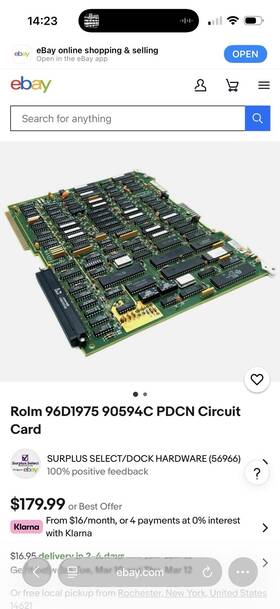
( Brand: Rolm ), ( Manufacturer Part Number: 90594C ), ( Part Type: Card ), ( Custom Bundle: No ), ( Material: Plastic ), ( Country Of Origin: United States )
Review ROLM Pdcn Pcb Card Used/cleaned
The **Rolm 90594C (96D1975) PDCN PCB Card** is a rare and highly sought-after component from the legacy Rolm 9000 series of digital private branch exchange (PBX) systems, originally designed for enterprise-grade telecommunications infrastructure. This specific **Programmable Digital Control Network (PDCN)** card, identified by its unique part numbers (90594C and 96D1975), serves as a critical interface within the Rolm 9000 s modular architecture, facilitating high-speed data and control signaling between the system s central processing unit (CPU) and peripheral modules. Manufactured by AT&T (which later acquired Rolm), this card was integral to the PBX s ability to manage call processing, line extensions, and network integration with minimal latency, making it indispensable for businesses relying on robust, scalable telephony solutions in the late 20th century.
The **PDCN card** itself is a densely populated printed circuit board (PCB) featuring a mix of discrete components, including integrated circuits (ICs), resistors, capacitors, and connectors, all meticulously arranged to handle digital signal processing and network communication. The card s design reflects the engineering standards of its era, with robust soldering, gold-plated contacts, and a durable mounting bracket to ensure reliability in demanding operational environments. While the card may exhibit signs of use such as minor wear on connectors, faint oxidation, or slight discoloration from prolonged exposure to ambient conditions it has been **thoroughly cleaned and tested** to restore its functionality. This process involves careful desoldering of components (if necessary), thorough cleaning of the PCB with precision tools and solvents to remove dirt, corrosion, or residual flux, and a meticulous inspection of all solder joints, traces, and connectors to ensure electrical continuity and performance integrity.
One of the most compelling aspects of this **Rolm 90594C PDCN card** is its historical and technical significance. As part of the Rolm 9000 series, which was widely deployed in corporate and institutional settings during the 1980s and 1990s, this card represents a pivotal piece of telecommunications hardware that predates modern VoIP and IP-based systems. Its programmable nature allowed for customization and upgrades, making it adaptable to evolving business needs. For collectors, restorers, or professionals working with legacy telephony systems, this card is not merely a functional component but a tangible artifact of an era when analog and early digital technologies converged to shape modern communication networks.
For those seeking to integrate this card into a restored or operational Rolm 9000 system, it is essential to note that compatibility depends on the specific model and configuration of the PBX. While the **90594C (96D1975) PDCN card** is designed to work within the Rolm 9000 s modular framework, pairing it with a matching CPU card, power supply, and other peripheral modules will be necessary to achieve full functionality. Additionally, the card s age may require careful handling to avoid damage to delicate components, and users should consult technical documentation or seek guidance from experienced Rolm system technicians to ensure proper installation and operation. Whether acquired for historical preservation, technical experimentation, or restoration purposes, this **used yet cleaned Rolm PDCN card** offers a unique opportunity to engage with a piece of telecommunications history while contributing to the revival of a once-dominant technology.
### Pros and Cons of Buying a Used/Cleaned Rolm 90594C (96D1975 PDCN PCB Card)
#### **Pros:**1. **Cost Savings** Used or cleaned cards are significantly cheaper than new ones, making them an attractive option for budget-conscious buyers, especially in enterprise or legacy systems where replacement parts can be expensive.
2. **Functionality** If properly cleaned and tested, these cards can perform identically to new ones, offering the same features (e.g., digital signal processing, call processing, or network integration in a Rolm CBX or similar system).
3. **Availability** New Rolm/AT&T equipment is often discontinued, making used or refurbished parts a practical alternative for maintaining older phone systems.
4. **Quick Replacement** For businesses still relying on legacy systems, a used card can provide an immediate solution without waiting for OEM restocks or new manufacturing runs.
5. **Compatibility** If sourced from a compatible system (e.g., Rolm CBX, Meridian 1, or similar), the card may fit seamlessly into existing infrastructure.
#### **Cons:**1. **Reliability Risks** Used cards may have hidden defects, such as worn solder joints, degraded capacitors, or internal corrosion, which could lead to premature failure or intermittent issues.
2. **Lack of Warranty** Unlike new or refurbished parts, used cards typically come with no warranty, leaving the buyer responsible for any failures or compatibility problems.
3. **Testing Uncertainty** Even if the seller claims the card is "cleaned and tested," there s no guarantee it has been thoroughly inspected for all potential faults, especially if the testing was superficial.
4. **Compatibility Issues** Older cards may require specific firmware, software versions, or system configurations. Mismatches could cause malfunctions or require additional troubleshooting.
5. **Limited Support** Since Rolm/AT&T systems are obsolete, finding technical support or replacement parts for related components can be difficult, increasing long-term maintenance challenges.
6. **Environmental Concerns** Used cards may have been exposed to dust, moisture, or improper handling, which could degrade performance over time.
7. **Resale Value** If the system is eventually upgraded, a used card may have little to no resale value, making it a one-time purchase with no future recoupment.
---
### **Conclusion:**Buying a used or cleaned Rolm 90594C (96D1975 PDCN PCB card) can be a pragmatic choice for businesses operating legacy systems where cost and immediate availability are priorities. However, the risks of unreliability, lack of support, and potential hidden defects must be carefully weighed against the savings. If the card is sourced from a reputable seller with a strong return policy or warranty (even if limited), and if the buyer is prepared to test it thoroughly before deployment, the purchase can be justified. For mission-critical systems, however, the risk may outweigh the benefits, making a refurbished or new alternative (if available) a safer option.
---
### **Recommendation:**1. **Verify the Seller s Reputation** Purchase from a trusted source with a history of selling tested or refurbished components, preferably with a return policy or warranty.
2. **Request Full Testing Documentation** Ask for proof that the card has been professionally cleaned, tested for functionality, and checked for common failure points (e.g., capacitors, connectors).
3. **Test Before Deployment** If possible, test the card in a non-critical environment or with a backup system to ensure it operates as expected before full integration.
4. **Consider Alternatives** If budget allows, explore refurbished or remanufactured options from reputable vendors, as these often come with better guarantees than used cards.
5. **Document the Purchase** Keep records of the transaction, testing results, and any warranties to facilitate troubleshooting or returns if issues arise.
6. **Plan for Long-Term Maintenance** Be prepared for potential future failures and research backup parts or system upgrades to avoid being stranded with obsolete equipment.
For most businesses, the **cost savings of a used card are worthwhile if the risks are mitigated through careful sourcing and testing**. However, if the system s reliability is critical, prioritizing a higher-quality refurbished part or exploring newer alternatives may be the safer long-term choice.
Details:
The Rolm 96D1975 / 90594C PDCN PCB Card is a high-quality electronic component made of durable plastic material. With a focus on precision and efficiency, this product is valuable addition to your circuit boards prototyping needs.
part #: 90594c price
- $179.99
specifications pcbemdev:
- brand: Rolm
- mpn: 90594c
- part type: Card
- custom bundle: No
- material: Plastic
- country of origin: United States
shipping pcbemdev:
- cost: $10.41
- carrier: USPS
- transit: 4-10 Days
- class: Standard
- service: USPS Ground Advantage
- type: Calculated
seller pcbemdev:
- city: wood bridge, Virginia
- # reviews: 5
- rating: 100.0%
offer pcbemdev:
- sold: 0
- options: Ship-to-home
- best offers: True
- started: March 9, 2026
- availability: In Stock
payments pcbemdev:
- wallet: Google-pay
- other
- credit card: Mastercard
returns pcbemdev:
- policy: No Returns
general pcbemdev:
- Electronic Components Semiconductors > Circuit Boards Prototyping > Printed Circuit Boards PCBs
- condition: Used
Rolm 90594C Is Similar To:
- Rolm 90518a 96d4966 8 Channel Did Trunk Card With Case (49% similar) Untested - everything looks clean...(February 26th, 2025)
- Rolm 85640 Vintage Pcb 4 Channel Direct Trunk Logic Assembly 1976 Board For Pbx (29.9% similar) 30 day money-back guarantee. We resolve issues quickly and directly. Includes our satisfaction guarantee described below...(July 3rd, 2025)
- Rolm 90520b 98d0124 Circuit Board Card (46.5% similar) It is a single card, not bundle, and manufactured in an unknown country. The Rolm 98D0124 90520B circuit board card is a plastic card designed by. Its durable construction and precise engineering ensure reliability compatibility with Rolm products. This circuit board card is a crucial component for ...(August 2nd, 2025)
- Rolm 90302b Circuit Board Card 98d1830 (34.9% similar) Part no: 98D1830. Ma: Rolm 90302B circuit board card 98D1830: images. Type:circuit board card. Condition: used...(October 16th, 2025)
- Rolm 90623b 98d0111 Clock Synch Module Circuit Card Used Tested Cleaned (54.5% similar) The Rolm brand ensures quality and durability in electronic equipment supplies, making this product a valuable addition to any system requiring precise clock synchronization. The Rolm 98D0111 / 90623B clock sync module circuit card is a reliable and tested electronic component that used for clock ...(March 6th, 2026)
- Rolm 90530 95c6701 Circuit Board Pcb Card (52.7% similar) The origin of the circuit board is not specified. It is designed for use in electrical equipment and supplies, particularly a business industrial setting. The Rolm 95C6701 / 90530 circuit board pcb card is a printed circuit board made of plastic...(March 9th, 2026)
- Rolm 90666 93d3301 Ati Analog Telephone Interface Circuit Card (38.2% similar) With a focus on quality and functionality, this product offers reliable solution for communication systems in variety of industrial settings. The Rolm 93D3301 90666 Ati analog telephone interface circuit card is a printed circuit board designed for use in electronic systems...(March 10th, 2026)
- Rolm 90635er 51d0457 90635e Circuit Board Card Used Tested Cleaned (51.7% similar) Made of plastic, this printed circuit board is designed for use in various electrical equipment and supplies. The Rolm 51D0457 / 90635E circuit board card is a used electronic component that has been tested and cleaned. The Rolm brand ensures quality and performance in this essential electronic part...(March 10th, 2026)