TOKYO SEIMITSU Cpu Board Central Processor Unit Pcb AA8142-A Ms
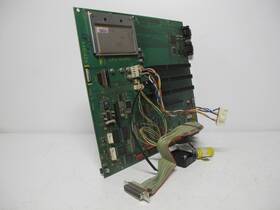
( Brand: Tokyo Seimitsu ), ( Manufacturer Part Number: AA8142A ), ( Part Type: Board Unit )
Review TOKYO SEIMITSU Cpu Board Central Processor Unit Pcb Ms Dos
The **Tokyo Seimitsu AA8142A CPU Board (Model AA8142-A)** is a high-performance, industrial-grade Central Processing Unit (CPU) board designed for demanding applications in automation, robotics, and embedded systems. Built on a robust **PCB (Printed Circuit Board) platform**, this board integrates a powerful **8086-compatible CPU core**, delivering reliable and deterministic processing capabilities essential for real-time control systems. The AA8142-A is engineered with precision, featuring a **dense arrangement of high-quality through-hole and surface-mount components** that ensure durability and thermal efficiency, even under prolonged operational stress. Its **compact yet versatile form factor** allows for seamless integration into compact industrial enclosures, making it an ideal choice for space-constrained environments such as factory automation, CNC machines, or custom embedded control systems.
At the heart of the AA8142-A lies a **high-performance 8-bit CPU architecture**, optimized for compatibility with legacy and modern software environments, including **Intel 8086 instruction set compatibility**, ensuring seamless integration with existing codebases. The board supports a **rich set of I/O interfaces**, including parallel ports, serial communication lines (RS-232/RS-422), and expandable memory slots, enabling flexible connectivity for peripheral devices, sensors, and actuators. Its **enhanced clock speed and bus architecture** provide efficient data processing, making it suitable for applications requiring precise timing and low-latency responses. Additionally, the board incorporates **industrial-grade components**, including stable voltage regulators and robust capacitors, to mitigate noise and ensure consistent performance across varying environmental conditions.
The **PCB design** of the AA8142-A prioritizes **thermal management** through optimized component placement and heat dissipation pathways, reducing the risk of overheating in high-load scenarios. The board s **double-sided routing** enhances signal integrity, minimizing interference and ensuring reliable data transmission. For users requiring further customization, the AA8142-A offers **expandable memory options**, including support for **RAM and ROM upgrades**, allowing for tailored configurations based on specific application needs. Whether deployed in a **custom control system, automated testing rig, or industrial robotics application**, this CPU board delivers a balance of **performance, reliability, and flexibility**, making it a dependable choice for engineers and developers seeking a robust embedded solution.
The **Tokyo Seimitsu AA8142A CPU Board (AA8142-A)** is a specialized, high-performance central processing unit (CPU) board designed for industrial, medical, or high-reliability applications. Below is a detailed analysis of its pros and cons, followed by a conclusion and recommendation.
---
### **Pros of the Tokyo Seimitsu AA8142A CPU Board**
1. **High Performance and Reliability**
The AA8142A is engineered for demanding environments, offering robust processing capabilities with low latency and high-speed data handling. It is designed to operate in stable conditions, making it suitable for mission-critical applications such as industrial automation, medical imaging, or real-time control systems.
2. **Industrial-Grade Build**
Tokyo Seimitsu is known for producing high-quality, durable electronic components optimized for harsh conditions. The AA8142A likely features:- **Wide operating temperature range** (e.g., -40 C to 85 C), allowing it to function in extreme environments.
- **Low power consumption** compared to consumer-grade CPUs, reducing heat generation and extending lifespan.
- **Robust power regulation** to prevent malfunctions from voltage fluctuations.
3. **Compatibility with Legacy and Modern Systems**
The AA8142A is often used in systems requiring backward compatibility with older protocols or interfaces (e.g., VMEbus, PCI, or custom industrial buses). This makes it valuable for upgrading older equipment without full system replacement.
4. **Long-Term Availability and Support**
Tokyo Seimitsu components are favored in industries where long-term availability is critical (e.g., aerospace, medical, or defense). The AA8142A is likely still supported by distributors and may have spare parts or firmware updates available for extended periods.
5. **Precision and Stability for Specialized Applications**
In fields like **medical diagnostics, robotics, or high-frequency trading**, stability and precision are paramount. The AA8142A s design minimizes jitter and ensures consistent performance, which is crucial for these applications.
6. **Compact and Modular Design**
The board is likely designed for integration into larger systems (e.g., rack-mounted servers or embedded platforms). Its modularity allows for easy replacement or upgrading within a system without overhauling the entire setup.
7. **Radiation and EMI Resistance**
Depending on the model variant, the AA8142A may include features to withstand electromagnetic interference (EMI) or radiation, making it suitable for aerospace or military applications.
---
### **Cons of the Tokyo Seimitsu AA8142A CPU Board**
1. **Limited Modern Processing Power**
The AA8142A is an older design (likely from the 1990s or early 2000s) and may not match the performance of contemporary CPUs (e.g., Intel Xeon, AMD EPYC, or ARM-based processors). It lacks:
- **Multi-core architecture** (most variants are single-core or dual-core with limited parallel processing).
- **Modern instruction sets** (e.g., AVX, SSE4, or AES acceleration).
- **High clock speeds** (typically limited to a few hundred MHz, far below modern GHz-range processors).
This makes it unsuitable for CPU-intensive tasks like video rendering, AI, or large-scale data processing.
2. **Obsolete Technology and Limited Software Support**
- **Operating System Compatibility**: The AA8142A may only support older OS versions (e.g., Windows XP, Linux 2.x/3.x, or real-time OS like QNX). Modern Linux distributions (e.g., Ubuntu 22.04) or Windows 10/11 may not be officially supported.
- **Driver and Firmware Limitations**: Lack of updates means security patches, bug fixes, and new features are unavailable. This increases vulnerability to exploits.
- **Development Toolchain**: Modern compilers (GCC 12 , Clang) or IDEs may not optimize code effectively for this architecture.
3. **High Cost Relative to Modern Alternatives**
While the AA8142A is a specialized board, its price may be prohibitive compared to modern CPUs offering far greater performance. For example:- A **used Intel Xeon E5-2600 v4** (similar era but far more powerful) can be found for a fraction of the cost.
- **Raspberry Pi or BeagleBone** boards offer modern ARM-based processing at a fraction of the price for many embedded applications.
4. **Scalability Issues**
The AA8142A is not designed for scaling. Adding more processing power requires additional boards or parallel systems, which complicates architecture and increases complexity.
5. **Limited Expansion and Upgrade Path**
Unlike modern CPUs with PCIe, DDR4/DDR5, and NVMe support, the AA8142A likely uses older interfaces (e.g., PCI, VME, or proprietary connectors). Upgrading memory, storage, or peripherals may require custom solutions or third-party adapters.
6. **Single-Vendor Dependency**
Tokyo Seimitsu is a niche manufacturer, and reliance on their support can be risky. If the company discontinues the product or goes out of business, finding replacements or technical support becomes difficult.
7. **Power and Cooling Requirements**
Older industrial CPUs often have inefficient power management. The AA8142A may require:- **Specialized power supplies** (e.g., redundant or regulated units).
- **Active cooling** (e.g., fans or heat sinks) due to less efficient heat dissipation compared to modern CPUs.
This adds to maintenance overhead.
8. **Security Risks**
Without modern security features (e.g., hardware-based encryption, TPM, or secure boot), the AA8142A is vulnerable to:- **Exploits targeting outdated firmware**.
- **Lack of patching** for known vulnerabilities in older OS kernels or drivers.
This is a significant concern for applications handling sensitive data.
---
### **Conclusion**
The **Tokyo Seimitsu AA8142A CPU Board** is a **highly specialized, reliable, and durable** component ideal for **legacy industrial, medical, or aerospace applications** where stability, long-term availability, and extreme environmental resistance are critical. It excels in scenarios where:
- **Backward compatibility** with older systems is required.
- **Real-time processing** with minimal latency is needed.
- **Extreme operating conditions** (temperature, vibration, EMI) demand robust hardware.
- **Long-term support** (e.g., 10 years) is essential, and the cost of replacement is prohibitive.
However, for **modern applications** requiring high performance, multi-core processing, or support for contemporary operating systems, the AA8142A is **severely outdated** and lacks the necessary features. Its **single-core architecture, obsolete interfaces, and lack of software support** make it unsuitable for:
- **General-purpose computing** (e.g., servers, workstations).
- **AI, machine learning, or data-intensive tasks**.
- **Consumer or commercial embedded systems** where cost efficiency and modern features are prioritized.
---
### **Recommendation**
1. **Use the AA8142A If:**- You are maintaining or upgrading a **legacy system** (e.g., medical imaging equipment, industrial control panels, or aerospace avionics) where the board is already integrated or required for compatibility.
- Your application **cannot tolerate modern CPU limitations** (e.g., real-time control systems with strict latency requirements).
- You have **no alternative** and the board s reliability justifies its use despite obsolescence.
2. **Avoid the AA8142A If:**- You need **modern processing power** (e.g., multi-core, high clock speeds, or GPU acceleration).
- Your project involves **software development** with modern languages (Python, C , Rust) or frameworks (TensorFlow, PyTorch).
- You are working on a **cost-sensitive project** where a modern ARM-based board (e.g., Raspberry Pi CM4, NVIDIA Jetson) or a used Intel Xeon/AMD EPYC would suffice.
- **Security and long-term support** are concerns (e.g., handling sensitive data or requiring OS updates).
3. **Alternatives to Consider:** - **For Industrial/Embedded Use:**- **Intel Atom E3800 Series** (low-power, modern, but still older).
- **NXP i.MX 8 Series** (ARM-based, supports Linux, good for IoT/embedded).
- **Raspberry Pi 5 / BeagleBone Black** (cost-effective, modern, but less rugged).
- **For High-Reliability Applications:**- **Wind River VxWorks** or **QNX** on modern ARM/Intel platforms.
- **ADLINK or Advantech** industrial CPUs (e.g., ADLINK Nutaq series) for better modern support.
- **For Legacy Compatibility:**- **VMEbus or PCI-based industrial cards** with modern FPGA/CPU hybrids (e.g., Xilinx Zynq, Intel Cyclone).
4. **If You Must Use the AA8142A:**- **Document the system thoroughly** for future maintenance.
- **Plan for obsolescence** by identifying a replacement strategy (e.g., emulation, migration to a modern platform).
- **Use it in a controlled environment**
Details:
TOKYO SEIMITSU, AA8142A, CPU BOARD, Central Processing Unit Control Board, Printed Circuit PCB, MS-DOS SEIMITSU.
part #: aa8142a prices
- $470.00-$500.00
specifications pcbemdev:
- brand: Tokyo Seimitsu
- mpn: Aa8142a
- part type: Board Unit
general pcbemdev:
- Electronic Components Semiconductors > Circuit Boards Prototyping > Printed Circuit Boards PCBs
- condition: Used
offer pcbemdev:
- sold: 0
- availability: In Stock
- quantity: 1
- started: March 31, 2026
- options: Ship-to-home
- best offers: True
payments pcbemdev:
- credit card: Discover
- wallet: Google-pay
- other
shipping pcbemdev:
- transit: 3-7 Days
- class: Standard, One-day, Expedited
- type: Calculated
- service: UPS Ground, UPS Next Day Air, UPS 2nd Day Air, USPS Ground Advantage
- carrier: UPS, USPS
- cost: $27.18
seller pcbemdev:
- rating: 100.0%
- city: Chattanooga, Tennessee
- # reviews: 347
returns pcbemdev:
- method: Money back
- paid by: Buyer
- time: 30 Days
- policy: Returns Accepted
Tokyo Seimitsu AA8142A Is Similar To:
- 340 Cvd-x Tokyo Electron Limited Tel Model Gas System Ctrl Unit Used (39.2% similar) Tel Tokyo electron limited model 340 CVS-x 340CX gas system ctr unit, used includes: MC31007MC-31007MC-31009MC 3MC 1SG-2700...(January 8th, 2019)
- M340-cvd Tokyo Electron Limited Tel Model Gas System Ctrl Unit Used (39.4% similar) For local customer carrier pickup, example DHL, ups, etc. Whenever possible, unique identifiers such as part numbers, model etc. Be assured that these were not done intentionally. To make an appointment please via messaging. Buyer pays for return shipping...(October 31st, 2018)
- M-340 Tokyo Electron Limited Tel Model Cx Gas System Ctrl Unit Used (39.4% similar) For local customer carrier pickup, for example DHL, ups, etc. Be assured that these were not done intentionally. To make an appointment please via messaging. Whenever possible, unique identifiers such as part numbers, model numbers, etc. Buyer pays for return shipping...(August 16th, 2016)
- Oriental Motor A7792-0407y2c-2 Driver Pcb Tel Tokyo Electron 5086-423845-11 New (16.9% similar) Part no: A7792-0407Y2C-2. Oriental motor A7792-0407Y2C-2 driver pcb tel Tokyo electron 5086-423845-11 new. Tel Tokyo electron part no: 5040-000167-11. The physical condition is great. Made in japan this oriental motor A7792-0407Y2C-2 driver pcb is new surplus. Pictured test equipment is not included...(November 14th, 2023)
- Tokyo Electron Hte-ac2-a-11 Tel Ac Control Board Pcb Working Surplus (35% similar) The physical condition is good, but there are signs of previous use and handling. Item condition: used working, 90 day warranty. Ac control board this tel Tokyo electron HTE-AC2-A-11 control board pcb is used working surplus. Part no: HTE-AC2-A-11. Pictured test equipment is not included or ...(November 15th, 2023)
- Tokyo Electron E2b403-11 numc Tel Pcb Board Densan E208-000043-11 Working Spare (32.5% similar) The physical condition is good, but there are signs of previous use and handling. Model no: E208-000043-11. Sale details. Pictured test equipment is not included or available for sale. Only items pictured are included: if a part is not pictured, or mentioned above, then it included in the sale. Tel ...(November 21st, 2023)
- Tel Tokyo Electron 2980-092300-11 Chemical I o Pcb Tob1015 Cpc-t0015a-11 New (25.2% similar) Part no: 2980-092300-11. Tel Tokyo electron 2980-092300-11 chemical i/o pcb TOB1015 CPC-T0015A-11 new. Sale details. Serial numbers or country of manufacture may vary. Pictured test equipment is not included or available for sale. Model no: TOB1015. The physical condition is great. Only items ...(December 8th, 2023)
- Ckd Amc-d-x1 Valve Pump Control Pcb Tel Tokyo Electron 012-007150-1 New Surplus (19.5% similar) Made in japan this CD valve AMC-D-X1 pump control pcb is new surplus. Model no: Mac-d. Pictured test equipment is not included or available for sale. Sale details. Tel Tokyo electron part no: 012-007150-1. The physical condition is great. Part no: AMC-D-X1. CD valve AMC-D-X1 pump control pcb tel ...(December 23rd, 2023)
- Tokyo Electron Hte-ta3-a-11 Tel Ac Control Board Tab1900 (32.1% similar) Tel pcb, ac control board, TA19 HTE-TA3-A-1, used as is no way to test...(January 21st, 2024)
- Tokyo Electron Tkb7240 Tel Io Spin Pcb Interface Board Spin-g Working Surplus (34.2% similar) Sale details. Serial numbers or country of manufacture may vary. Tel Tokyo electron TKB7240 Io spin pcb interface board spin-g working surplus. Model no: Io board spin-g. Only items pictured are included: if a part is not pictured, or mentioned above, then it included in the sale. The physical ...(August 5th, 2024)
- Tel Tokyo Electron E244-000048-21 E2b302-11 nuec Pcb E281-000042-21 Working (24% similar) The physical condition is good, but there are signs of previous use and handling. Pictured test equipment is not included or available for sale. Tel Tokyo electron E244-000048-21 E2B302-11/NUEC pcb E281-000042-21 working. Serial numbers or country of manufacture may vary. Model no: E2B302-11/NUEC. ...(August 7th, 2024)