TOKYO SEIMITSU AA8155 Board Circuit Control Pcb SNS64
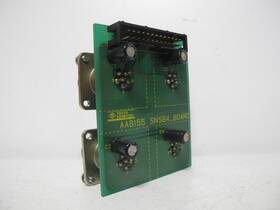
( Brand: Tokyo Seimitsu ), ( Manufacturer Part Number: AA8155 ), ( Part Type: Circuit Control Board )
Review TOKYO SEIMITSU Board Circuit Control Pcb
The **Tokyo Seimitsu AA8155 SNS64 Board** is a high-performance, precision-engineered circuit control PCB designed for demanding applications in industrial automation, robotics, and advanced motion control systems. This compact yet robust board integrates a sophisticated **8-axis servo drive control system** with seamless integration capabilities, making it an ideal solution for applications requiring synchronized, high-speed motion control with exceptional accuracy. Built upon Tokyo Seimitsu s reputation for reliability and precision, the AA8155 leverages cutting-edge **SNS64 technology**, which ensures minimal signal delay, superior noise immunity, and efficient power management critical factors in dynamic environments where real-time responsiveness is essential. The board features a **high-density, multi-layer PCB layout** optimized for signal integrity, with dedicated isolation circuits to prevent cross-talk and ensure stable operation even under heavy loads. Its modular design allows for easy expansion, accommodating up to eight servo axes while maintaining a compact footprint, making it suitable for integration into space-constrained systems without compromising performance.
At its core, the AA8155 employs **advanced digital signal processing (DSP)** and **real-time control algorithms** to deliver smooth, precise motion profiles with minimal overshoot and settling time. The board supports a wide range of communication protocols, including **CANopen, EtherCAT, and RS-485**, enabling seamless interfacing with PLCs, HMIs, and other industrial networks. Its **high-current output capability** ensures robust driving of high-performance servo motors, while built-in **overcurrent, overvoltage, and short-circuit protection** safeguards both the board and connected components from potential damage. The SNS64 architecture further enhances its versatility by supporting **position, velocity, and torque control modes**, allowing engineers to fine-tune performance for specific applications such as CNC machining, robotic arms, or automated assembly lines. Additionally, the AA8155 incorporates **diagnostic and monitoring functions**, providing real-time feedback on system health, motor status, and fault conditions, which simplifies troubleshooting and maintenance.
Designed with **industrial durability in mind**, the AA8155 operates within a wide temperature range and features ruggedized components to withstand harsh environments, including exposure to vibration and electromagnetic interference. Its **user-friendly configuration interface** allows for easy parameter tuning via onboard potentiometers or external communication tools, while the **low-latency response** ensures that even the most complex motion sequences execute with flawless precision. Whether deployed in a high-speed packaging system, a precision manufacturing setup, or a research-grade robotic platform, the AA8155 SNS64 Board delivers a balance of power, flexibility, and reliability that sets it apart as a premium solution for next-generation motion control applications. Its integration of advanced hardware and software engineering ensures that engineers and technicians can focus on innovation rather than overcoming limitations, making it a cornerstone for next-level automation projects.
**Overview of the Tokyo Seimitsu AA8155 SNS64 Board (Circuit Control PCB)**
The **Tokyo Seimitsu AA8155 SNS64** is a specialized **SNS (Single-Network System) control board** commonly used in **automated production lines, CNC machines, and industrial robotics** for precise circuit control, signal processing, and motor/actuator coordination. Below is a detailed analysis of its pros and cons, followed by a conclusion and recommendation.
---
### **Pros**
1. **High Precision and Reliability**
The board is designed for **industrial-grade applications**, offering **low latency and high-speed signal processing**, which is critical for automated systems requiring millisecond-level responses. Its robust construction ensures **long-term stability** in harsh environments.
2. **Compatibility with SNS (Single-Network System)**
The SNS64 interface allows for **simplified wiring and reduced cable clutter** compared to traditional multi-wire setups. This system is widely used in **Japanese industrial automation**, making it a natural fit for systems already integrated with Tokyo Seimitsu or similar manufacturers.
3. **Modular and Expandable Design**
The AA8155 supports **multiple I/O extensions**, allowing users to add **more sensors, actuators, or control modules** as needed. This flexibility makes it suitable for **customized automation setups** without requiring a complete system overhaul.
4. **Compatibility with PLCs and CNC Systems**
It integrates seamlessly with **PLCs (Programmable Logic Controllers)** and **CNC machines**, making it ideal for **hybrid control systems** where both discrete and continuous motion control are required.
5. **Durability and Industrial Build**
Constructed for **industrial use**, the board is built to withstand **vibration, temperature fluctuations, and electrical noise**, reducing downtime due to hardware failure.
6. **Support for High-Speed Data Transmission**
The **64-channel SNS interface** enables **fast data exchange** between control units and peripheral devices, which is essential for **real-time process control** in manufacturing.
7. **Backward and Forward Compatibility**
Many models in the AA series are designed to work with **legacy systems** while also supporting **modern industrial protocols**, ensuring longevity in evolving automation environments.
8. **Easy Integration with Tokyo Seimitsu Ecosystem**
If you already use **Tokyo Seimitsu motors, drives, or sensors**, this board ensures **seamless interoperability**, reducing compatibility issues and simplifying maintenance.
---
### **Cons**
1. **Limited Global Availability and Support**
Tokyo Seimitsu is **primarily a Japanese manufacturer**, meaning **parts, documentation, and technical support may be harder to access outside Japan**. This could lead to **longer lead times for repairs or replacements**.
2. **Learning Curve for Non-Japanese Users**
The **SNS protocol and documentation** are often **written in Japanese**, requiring **language proficiency or translation services** for proper configuration. This can be a barrier for engineers unfamiliar with Japanese industrial standards.
3. **Potential High Initial Cost**
While the board itself may not be extremely expensive, **integration costs** (wiring, programming, testing) can add up, especially for **small-scale or custom applications**. The long-term ROI depends heavily on the specific use case.
4. **Vendor Lock-In Risk**
Since the board is **optimized for Tokyo Seimitsu s ecosystem**, migrating to **alternative brands (e.g., Mitsubishi, Siemens, Omron)** later may require **significant rework**, increasing long-term flexibility costs.
5. **Limited Open-Source or Third-Party Support**
Unlike some **open-standard PLCs or control systems**, the AA8155 does not have **extensive community-driven documentation or third-party plugins**, which can complicate troubleshooting for non-experts.
6. **Physical Size and Installation Constraints**
The board may be **bulkier than modern compact PLC modules**, requiring **additional space in control cabinets**. This could be a limitation in **space-constrained industrial setups**.
7. **Dependence on Japanese Industrial Standards**
Some **protocol implementations or signal conventions** may differ from **international standards (e.g., IEC 61131-3)**, requiring additional adaptation efforts for global compliance.
8. **Potential for Obsolescence**
While Tokyo Seimitsu products are durable, **older models may eventually be discontinued**, leaving users without **new firmware updates or hardware replacements** as the company shifts focus.
---
### **Conclusion**
The **Tokyo Seimitsu AA8155 SNS64 board** is a **highly capable, reliable, and precise** control solution for **industrial automation systems**, particularly those already integrated with Tokyo Seimitsu hardware. Its **SNS interface, modularity, and industrial-grade build** make it well-suited for **high-performance applications** where **low latency and signal integrity** are critical.
However, its **limited global support, Japanese-centric documentation, and potential vendor lock-in** pose challenges, especially for **smaller businesses or non-Japanese users**. If you are **already using Tokyo Seimitsu components** or have **dedicated technical support**, this board is an **excellent choice**. For users seeking **greater flexibility, open standards, or global support**, alternative brands (e.g., **Mitsubishi FX, Siemens S7, or Omron CP1E**) may offer better long-term adaptability.
---
### **Recommendation**
- **Buy the AA8155 if:**- You are **already part of a Tokyo Seimitsu ecosystem** (motors, drives, sensors).
- Your application requires **high-speed, low-latency control** with **SNS compatibility**.
- You have **access to Japanese-language technical support** or a **local expert**.
- Your budget allows for **potential higher initial costs** in exchange for **long-term reliability**.
- **Consider alternatives if:**- You need **global availability and easier support**.
- Your project requires **open-standard PLCs (e.g., Modbus, Profibus, Ethernet/IP)**.
- You anticipate **future scalability beyond Tokyo Seimitsu s ecosystem**.
- **Cost efficiency** is a priority, and you can find **equally capable but more widely supported** boards (e.g., **Mitsubishi FX series, Siemens S7-1200**).
For **new projects without existing Tokyo Seimitsu integration**, a **hybrid approach** using the AA8155 for **SNS-compatible peripheral control** while pairing it with a **more globally supported PLC** could balance **specialized performance with flexibility**. Always **evaluate long-term maintenance and training costs** before committing.
Details:
TOKYO SEIMITSU, AA8155 SNS64 Board, Control Printed Circuit PCB SEIMITSU.
part #: aa8155 price
- $40.00
specifications pcbemdev:
- brand: Tokyo Seimitsu
- mpn: Aa8155
- part type: Circuit Control Board
returns pcbemdev:
- method: Money back
- time: 30 Days
- paid by: Buyer
- policy: Returns Accepted
payments pcbemdev:
- credit card: Discover
- other
- wallet: Apple-pay
shipping pcbemdev:
- service: UPS Ground, UPS Next Day Air, UPS 2nd Day Air, USPS Ground Advantage
- transit: 3-7 Days
- cost: $13.17
- carrier: UPS, USPS
- type: Calculated
- class: Standard, One-day, Expedited
general pcbemdev:
- Electronic Components Semiconductors > Circuit Boards Prototyping > Printed Circuit Boards PCBs
- condition: Used
seller pcbemdev:
- rating: 100.0%
- # reviews: 347
- city: Chattanooga, Tennessee
offer pcbemdev:
- best offers: True
- options: Ship-to-home
- started: March 31, 2026
- availability: In Stock
- quantity: 1
- sold: 0
Tokyo Seimitsu AA8155 Is Similar To:
- Oriental Motor A7792-0407y2c-2 Driver Pcb Tel Tokyo Electron 5086-423845-11 New (18.1% similar) Part no: A7792-0407Y2C-2. Oriental motor A7792-0407Y2C-2 driver pcb tel Tokyo electron 5086-423845-11 new. Tel Tokyo electron part no: 5040-000167-11. The physical condition is great. Made in japan this oriental motor A7792-0407Y2C-2 driver pcb is new surplus. Pictured test equipment is not included...(November 14th, 2023)
- Tokyo Electron Hte-ac2-a-11 Tel Ac Control Board Pcb Working Surplus (43.6% similar) The physical condition is good, but there are signs of previous use and handling. Item condition: used working, 90 day warranty. Ac control board this tel Tokyo electron HTE-AC2-A-11 control board pcb is used working surplus. Part no: HTE-AC2-A-11. Pictured test equipment is not included or ...(November 15th, 2023)
- Tokyo Electron E2b403-11 numc Tel Pcb Board Densan E208-000043-11 Working Spare (27.8% similar) The physical condition is good, but there are signs of previous use and handling. Model no: E208-000043-11. Sale details. Pictured test equipment is not included or available for sale. Only items pictured are included: if a part is not pictured, or mentioned above, then it included in the sale. Tel ...(November 21st, 2023)
- Tel Tokyo Electron 2980-092300-11 Chemical I o Pcb Tob1015 Cpc-t0015a-11 New (25.5% similar) Part no: 2980-092300-11. Tel Tokyo electron 2980-092300-11 chemical i/o pcb TOB1015 CPC-T0015A-11 new. Sale details. Serial numbers or country of manufacture may vary. Pictured test equipment is not included or available for sale. Model no: TOB1015. The physical condition is great. Only items ...(December 8th, 2023)
- Ckd Amc-d-x1 Valve Pump Control Pcb Tel Tokyo Electron 012-007150-1 New Surplus (23.6% similar) Made in japan this CD valve AMC-D-X1 pump control pcb is new surplus. Model no: Mac-d. Pictured test equipment is not included or available for sale. Sale details. Tel Tokyo electron part no: 012-007150-1. The physical condition is great. Part no: AMC-D-X1. CD valve AMC-D-X1 pump control pcb tel ...(December 23rd, 2023)
- Tokyo Electron Hte-ta3-a-11 Tel Ac Control Board Tab1900 (44.6% similar) Tel pcb, ac control board, TA19 HTE-TA3-A-1, used as is no way to test...(January 21st, 2024)
- Tokyo Electron Tkb7240 Tel Io Spin Pcb Interface Board Spin-g Working Surplus (31% similar) Sale details. Serial numbers or country of manufacture may vary. Tel Tokyo electron TKB7240 Io spin pcb interface board spin-g working surplus. Model no: Io board spin-g. Only items pictured are included: if a part is not pictured, or mentioned above, then it included in the sale. The physical ...(August 5th, 2024)
- Tel Tokyo Electron E244-000048-21 E2b302-11 nuec Pcb E281-000042-21 Working (24.3% similar) The physical condition is good, but there are signs of previous use and handling. Pictured test equipment is not included or available for sale. Tel Tokyo electron E244-000048-21 E2B302-11/NUEC pcb E281-000042-21 working. Serial numbers or country of manufacture may vary. Model no: E2B302-11/NUEC. ...(August 7th, 2024)
- Tokyo Electron Hte-tc3-a-11 Control I f Pcb Board (40.4% similar) Tokyo electron HTE-TC3-A-11 control i/f pcb board...(August 16th, 2024)
- Tokyo Electron Mpc-t0048a-11 Pcb Board (31.1% similar) Tokyo electron MPC-T0048A-11 pcb board...(August 16th, 2024)
- Tel Oydk-059 Tokyo Electron Pcb Board (29.4% similar) Tel Tokyo electron OYDK-059 pcb board...(August 19th, 2024)