NATIONAL INSTRUMENTS ASSY188429A-01 Ni Elvis Prototyping Lab Board Breadboard
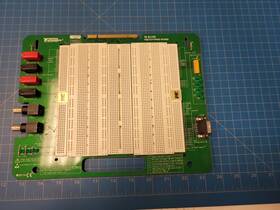
( Brand: National Instruments ), ( Manufacturer Part Number: ASSY188429A-01 ), ( Part Type: Board )
Review NATIONAL INSTRUMENTS Ni Elvis Prototyping Board Breadboard Electronics Lab
The **National Instruments NI ELVIS II Prototyping Board (Assy188429A-01)** is a versatile, high-performance educational and development platform designed to bridge the gap between theory and hands-on experimentation in electronics, control systems, and embedded design. This meticulously engineered breadboard lab combines the flexibility of a traditional prototyping area with the precision and integration of modern instrumentation, making it an indispensable tool for students, engineers, and hobbyists alike. At its core, the NI ELVIS II features a **160-point solderless breadboard** with a grid layout optimized for clean, organized circuit assembly, allowing users to prototype analog, digital, and mixed-signal designs without the hassle of soldering or messy wiring. The breadboard s durable, high-quality construction ensures stable connections and minimizes signal interference, while its modular design accommodates a wide range of components, from basic resistors and capacitors to complex ICs and sensors.
Beyond the breadboard, the NI ELVIS II integrates seamlessly with the **NI ELVIS II platform**, a self-contained hardware system that consolidates essential instrumentation including a **16-bit, 250 kS/s analog-to-digital converter (ADC)**, **16-bit, 500 kS/s digital-to-analog converter (DAC)**, **16-channel digital I/O**, and **PWM outputs** into a single, compact unit. This integration eliminates the need for external signal generators, oscilloscopes, or data acquisition devices, streamlining experiments in signal processing, control systems, and embedded programming. The platform s **USB connectivity** enables real-time data acquisition, visualization, and analysis using **LabVIEW**, NI s intuitive graphical programming environment, or other compatible software, allowing users to capture, plot, and manipulate signals with ease. Whether testing a simple RC filter, implementing a PID controller, or experimenting with microcontroller interfaces, the NI ELVIS II provides the tools needed to visualize and refine designs in real time.
One of the standout features of this prototyping board is its **compatibility with a vast ecosystem of NI hardware and software**, including **LabVIEW, LabVIEW NXG, and LabVIEW Embedded Module**, which extend its functionality to advanced applications like motor control, wireless communication, and AI-driven signal processing. The board s **standardized pinout and modular design** also make it easily adaptable for interfacing with external sensors, actuators, and other third-party devices, such as Arduino, Raspberry Pi, or FPGA modules, expanding its utility across disciplines. Additionally, the NI ELVIS II is equipped with **built-in power supplies**, including a **regulated 5V and 3.3V output**, as well as a **variable power supply** for testing circuits under different voltage conditions, ensuring compatibility with a broad spectrum of components.
For educational environments, the NI ELVIS II is an exceptional teaching tool, as it fosters a **hands-on, project-based learning approach**. Its **pre-loaded curriculum resources**, including lab manuals, virtual instruments, and ready-to-use experiments, guide users through foundational concepts in electronics, control theory, and embedded systems while encouraging creativity and problem-solving. The platform s **durability and ease of use** make it ideal for both classroom demonstrations and independent study, while its **open architecture** allows for customization and expansion, catering to both beginners and experienced practitioners. Whether used in a university lab, a maker space, or a professional development setting, the NI ELVIS II Prototyping Board stands as a testament to innovation in educational technology, empowering users to explore, experiment, and innovate with confidence.
### Pros and Cons of buying a National Instruments ELVIS II Prototyping Board (NI ELVIS Prototyping Board, Assy188429A-01)
#### **Pros:**1. **Versatility and Educational Value**
The NI ELVIS II is a highly versatile educational tool designed for hands-on learning in electronics, control systems, and signal processing. It integrates a wide range of built-in instruments, including oscilloscopes, function generators, multimeters, and logic analyzers, which are essential for prototyping and debugging circuits. This makes it ideal for students, hobbyists, and professionals learning about embedded systems, signal processing, or control engineering.
2. **Built-in Instruments**
Unlike traditional breadboards or basic prototyping boards, the ELVIS II includes integrated instruments that eliminate the need for external equipment. This saves space, reduces clutter, and streamlines experimentation. The oscilloscope, function generator, and other tools are accessible directly from the board, allowing for seamless testing and measurement without additional hardware.
3. **Compatibility with LabVIEW and NI Software**
The ELVIS II is fully compatible with National Instruments' LabVIEW and other NI software platforms. This integration enables users to create custom virtual instruments (VIs) and automate experiments, which is particularly valuable for advanced projects, data logging, and real-time signal processing. It bridges the gap between hardware and software, making it a powerful tool for both learning and professional development.
4. **Modular and Expandable Design**
The board supports a variety of modules and accessories, such as the NI ELVIS II Power Module, which provides additional power supply options. It also works with other NI modules like the Digital I/O Module or the RF Module, expanding its functionality for specific applications like digital logic design, RF experimentation, or motor control. This modularity ensures that the board can grow with the user's needs.
5. **Durability and Quality**
National Instruments is a reputable brand known for producing high-quality, reliable equipment. The ELVIS II is built to withstand frequent use in educational or laboratory settings, with robust components and a sturdy design. This durability reduces the risk of equipment failure during experiments, making it a long-term investment.
6. **Pre-Configured for Common Experiments**
The ELVIS II comes with pre-loaded examples and tutorials for common experiments in electronics, such as RC circuits, filters, motor control, and sensor interfacing. This makes it easier for beginners to start experimenting without needing extensive prior knowledge. The included software and documentation provide step-by-step guidance for a wide range of projects.
7. **Portability**
The compact and self-contained design of the ELVIS II makes it portable, allowing users to take it to different locations or share it among collaborators. This is particularly useful in educational settings where multiple users may need access to the equipment.
8. **Support for Advanced Topics**
Beyond basic electronics, the ELVIS II supports advanced topics such as digital signal processing (DSP), control systems (PID tuning), and embedded programming (e.g., using Arduino or Raspberry Pi compatibility). This makes it suitable for both introductory and advanced courses in engineering and computer science.
---
#### **Cons:**1. **High Cost**
The NI ELVIS II is significantly more expensive than traditional breadboards or basic prototyping boards. For hobbyists or students on a tight budget, the cost may be prohibitive, especially when compared to alternatives like Arduino-compatible prototyping kits or low-cost oscilloscopes. The price point is justified by its advanced features, but it may not be practical for casual users or those with limited funding.
2. **Steep Learning Curve**
While the ELVIS II is designed for educational purposes, its full potential requires familiarity with LabVIEW and other NI software tools. Beginners may find the initial setup and software configuration overwhelming, particularly if they lack experience with programming or virtual instrumentation. This could slow down the learning process for those new to electronics or software-based experimentation.
3. **Overkill for Simple Projects**
For basic electronics projects such as testing simple circuits with resistors, capacitors, or LEDs the ELVIS II offers more functionality than necessary. Users working on straightforward projects may find themselves paying for features they rarely use. A standard breadboard or a low-cost oscilloscope might suffice for these tasks, making the ELVIS II unnecessary in such cases.
4. **Dependence on NI Software Ecosystem**
The ELVIS II is tightly integrated with National Instruments' software, which can be a limitation if the user prefers alternative tools. For example, if someone is more comfortable with Python-based tools like PyVISA or MATLAB, they may need to adapt their workflow to use LabVIEW or other NI-compatible software. This dependency can be restrictive for users who rely on open-source or third-party tools.
5. **Limited Physical Prototyping Space**
While the ELVIS II includes a breadboard area for physical prototyping, the space may be limited compared to larger breadboards or soldering-based prototyping boards. Users working on complex circuits with many components may find the breadboard area insufficient, requiring additional external space or modular expansion.
6. **Maintenance and Technical Support**
Although NI is a well-established company, maintenance and technical support for the ELVIS II may not be as readily available as for more common or open-source hardware. Users may encounter delays in resolving hardware or software issues, particularly if they are not part of an educational institution with dedicated support.
7. **Compatibility Issues with Non-NI Tools**
Some users may encounter compatibility issues when trying to interface the ELVIS II with non-NI tools or third-party hardware. For example, integrating it with open-source microcontrollers like Arduino or ESP32 may require additional drivers or workarounds, which could complicate the setup process.
8. **Bulk Purchase Limitations**
While the ELVIS II is excellent for individual learning or small-group projects, purchasing multiple units for a classroom or team setting can be costly. Educational institutions may need to consider bulk discounts or alternative solutions to make it feasible for large-scale use.
---
### **Conclusion**
The National Instruments ELVIS II Prototyping Board is a powerful, all-in-one tool that excels in educational and professional settings where advanced instrumentation, software integration, and modular experimentation are required. Its built-in instruments, compatibility with LabVIEW, and support for a wide range of experiments make it an invaluable resource for students, engineers, and hobbyists working on complex projects. However, its high cost, steep learning curve, and overkill nature for simple projects may deter casual users or those with limited budgets. Additionally, its dependency on NI software and limited physical prototyping space could be drawbacks for users with alternative preferences or larger-scale projects.
For users who prioritize versatility, software integration, and long-term educational value, the ELVIS II is an excellent investment. For those working on basic electronics projects or seeking a more budget-friendly option, alternatives like Arduino-compatible prototyping boards, low-cost oscilloscopes, or traditional breadboards may be more suitable.
---
### **Recommendation**
**Buy the NI ELVIS II if:**- You are a student, educator, or professional working in electronics, control systems, or signal processing, and you need a comprehensive tool for hands-on learning and experimentation.
- You are comfortable or willing to learn LabVIEW and other NI software tools, and you value the integration of hardware and software for advanced projects.
- You require built-in instruments (oscilloscope, function generator, etc.) and modular expandability for a wide range of experiments.
- You are part of an educational institution or a team that can justify the cost based on its long-term value and scalability.
**Avoid the NI ELVIS II if:**- You are working on simple electronics projects and do not need advanced instrumentation or software integration.
- You are on a tight budget and can achieve similar results with more affordable alternatives like Arduino, Raspberry Pi, or basic prototyping boards.
- You prefer open-source tools or non-NI software and are uncomfortable with the learning curve associated with LabVIEW.
- You require extensive physical prototyping space for large or complex circuits, as the built-in breadboard may be limiting.
For most hobbyists or beginners, starting with a more affordable prototyping board or Arduino kit may be a better first step before investing in the ELVIS II . However, for those committed to deep learning in electronics and control systems, the ELVIS II is a highly recommended tool.
Details:
If an item is marked Untested or Parts Only, it simply means we lack the time, equipment, knowledge to test properly. Any props or background items are not included. Nothing more, nothing less.If a power cord, battery, or accessory is not clearly shown, please assume it included. The Trade-off: Priced lower due to risk.
NI ELVIS Prototyping Board National Instruments Breadboard Electronics Lab. Count squares in the photos to gauge size. Use the grid: white lines are spaced inch apart.
part #: assy188429a01 prices
- $48.74-$51.99
specifications pcbemdev:
- brand: National Instruments
- mpn: Assy188429a-01
- part type: Board
offer pcbemdev:
- best offers: True
- sold: 0
- started: April 7, 2026
- options: Ship-to-home
- quantity: 1
- availability: In Stock
returns pcbemdev:
- method: Money back
- paid by: Buyer
- policy: Returns Accepted
- time: 30 Days
payments pcbemdev:
- wallet: Apple-pay
- other
- credit card: Visa
shipping pcbemdev:
- transit: 3-9 Days
- cost: $10.81
- carrier: USPS, UPS, FedEx
- service: USPS Ground Advantage, UPS Ground, FedEx Ground Economy
- type: Calculated
- class: Standard, Economy
general pcbemdev:
- Electronic Components Semiconductors > Circuit Boards Prototyping > Printed Circuit Boards PCBs
- condition: Used
seller pcbemdev:
- city: Southlake, Texas
- rating: 99.6%
- # reviews: 4126
National Instruments ASSY188429A-01 Is Similar To:
- 180835-01 National Instruments Multifunction Board For Isa (50.3% similar) National Instruments lab-PC multi function I o board for ISS...(January 10th, 2019)
- 183893c-01 Block Module Instruments National 183986d-01 Ni Terminal Card (38.5% similar) Your satisfaction is extremely important to us. Compatibility issues are not considered DOA. This unit has been used. An image to National Instruments 183893C 01 terminal block card module with National Instruments 183986D 01 card model 183893C 01 dimensions l w8 3 approx. Save packaging for carrier...(May 13th, 2015)
- Module 183986d-01 Card Ni Block Instruments Terminal 183893c-01 National (36% similar) Compatibility issues are not considered DOA. Our contact SC asset management, inc. Cash is only accepted for will calls. If you accidentally peel the top plastic off, exposing the foam, just look for the next layer of plastic to lift the foam out cleanly. Lift foam out of box by grabbing 2ND plastic...(May 3rd, 2015)
- 551600014-001 National Semiconductor Evaluation Board Pn Nos (34.9% similar) Call to make arrangements. WYSIWYG what you see is get. Are not included. Accessories, cables, probes etc. The evaluation board operates at 300 khz, a good compromise between conversion efficiency, trade offs buck and buck-boost mode requirements, converter size. New old stock, and is being sold as ...(March 27th, 2019)
- 779511-01 National Instuments Nos Instruments Series Prototyping Accessory (47.9% similar) ...(October 29th, 2018)
- Cb-50lp-term National Instruments Nos Connector Block Term Cable (43.1% similar) For items not made in the us. Canadian buyers: must pay GST or HST, as applicable at background s: . Purchaser pays all shipping, and related expenses, unless it says free shipping. New old stock. Are not included. Just to make arrangements. It is being sold as is, pictured. Please review the ...(October 12th, 2018)
- Cb-58lpr National Instruments Cb-68lpr 68-pin (40.3% similar) Cosmetically, it is in excellent condition. This is a used, guaranteed-good un shielded 68-PIN I o connector block for applications such as connecting to National Instruments data acquisition devices. It is Nationals pn CB-58LPR. I will usually reply within 24 hr. Satisfaction is guaranteed on this ...(April 29th, 2017)
- 105-135vac Control Board National Controls Dnc-t2003-a10 Programmable 50 60hz (30.1% similar) Do not forget about any other charges which are charged by the carrier. National controls DC T2003 A10 programmable control board 105 135VAC 50 60HZ this item is used and untested. Item details approx...(March 2nd, 2016)
- Gpib-pciia National Instrument Pc Board (42.2% similar) ...(June 18th, 2017)
- 5212l-4a Hp Vintage Series 401 Circuit Board National Counter Nixie Tube (23.6% similar) Please where I have many great deals at great prices and I am flexible with reasonable offers. Shipping and price discounts on multiple items and orders. It is the series 401 circuit board. Minor signs of light scuffs. It is used and good physical and working condition. With great care with bubble ...(May 19th, 2016)
- 1970-0009 335 National Nixie Hp Tube Vintage Circuit 5245l-4b Board Series (34.4% similar) Comes as shown in our pictures. Please see our pictures for more details. Vintage hp 5245L 4b series 335 circuit board with National electronics Dixie tube. 14 day warranty. Pulled from a working Hewlett Packard 5245L electronic counter...(October 3rd, 2015)