TDK B1325415 Ricog Pro High Voltage Potential Sensor Board C651EX
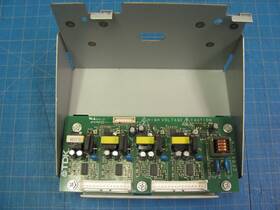
( Brand: Tdk ), ( Manufacturer Part Number: B1325415 ), ( Part Type: Voltage Sensor Board )
Review TDK Ricog Pro High Voltage Potential Sensor Board Used
The **TDK B1325415 RICOG PRO C651EX High Voltage Potential Sensor Board** is a cutting-edge, high-performance solution engineered for precise monitoring and protection in demanding industrial, automotive, and renewable energy applications. Designed with TDK s renowned expertise in sensor technology, this advanced board integrates a robust **Hall-effect-based potential sensor** optimized for high-voltage systems, delivering unparalleled accuracy, reliability, and durability in harsh operating environments. The C651EX module leverages TDK s proprietary **RICOG PRO** technology, which combines high-resolution analog front-end circuitry with digital signal processing to ensure real-time, low-noise detection of voltage potentials even in the presence of electromagnetic interference (EMI) or transient surges. With an operating range extending up to ** 1,000V DC** and a high common-mode rejection ratio (CMRR), this sensor board excels in applications such as battery management systems (BMS), electric vehicle (EV) charging infrastructure, photovoltaic (PV) inverters, and industrial motor drives, where precise voltage monitoring is critical for safety, efficiency, and system integrity.
The **B1325415** stands out for its **high isolation voltage rating of 5,000V RMS**, ensuring robust protection against electrical faults and transient overvoltages that could compromise system performance or pose safety risks. Its compact, modular design allows for seamless integration into existing control systems, while the **I C or SPI communication interface** enables flexible data acquisition and integration with microcontrollers, FPGAs, or PLCs. The sensor board features **low-power consumption**, making it ideal for battery-powered or energy-efficient applications, and its **wide temperature operating range ( 40 C to 125 C)** ensures consistent performance in extreme climates, from automotive under-hood environments to industrial outdoor installations. Additionally, the **high linearity and wide dynamic range** of the sensor minimize measurement errors, providing engineers with the confidence to implement precise voltage monitoring in critical applications where even minor deviations could lead to system failures or safety hazards.
Beyond its technical specifications, the **RICOG PRO C651EX** is built with **industrial-grade reliability**, featuring **reinforced insulation, overvoltage protection circuitry, and robust packaging** to withstand mechanical stress, vibration, and environmental contaminants. TDK s commitment to quality assurance is evident in the sensor s **long-term stability and low drift characteristics**, reducing the need for frequent recalibration and ensuring dependable performance over extended operational lifespans. Whether deployed in **high-voltage DC (HVDC) transmission systems, hybrid/electric vehicle architectures, or renewable energy storage solutions**, this sensor board serves as a cornerstone for intelligent voltage management, enabling predictive maintenance, fault detection, and optimized energy utilization. By combining **superior sensing accuracy with robust protection features**, the **TDK B1325415 RICOG PRO C651EX** empowers engineers to build safer, more efficient, and future-proof electrical systems in an increasingly complex energy landscape.
The **TDK B1325415 RICOG Pro C651EX High Voltage Potential Sensor Board** is a specialized component used in high-voltage applications, particularly in electric vehicle (EV) charging systems, inverters, and other power electronics. Below is a detailed breakdown of its pros and cons, followed by a conclusion and recommendation.
---
### **Pros**
1. **High Voltage Compatibility**
The sensor board is designed for high-voltage applications, typically up to **1,500V DC**, making it suitable for EV charging stations, bidirectional chargers, and industrial power systems. This ensures accurate sensing in environments where standard low-voltage sensors would fail or be unsafe.
2. **Isolation and Safety**
It incorporates **optical isolation** (likely via a photodiode or similar technology) to prevent direct electrical contact between the high-voltage side and the control circuitry. This reduces the risk of electrical shock and improves system reliability.
3. **Precision and Accuracy**
The sensor is optimized for **high-voltage potential measurement**, providing accurate readings of voltage levels. This is critical for monitoring charging states, fault detection, and ensuring safe operation in EV infrastructure.
4. **Compatibility with RICOG Pro Platform**
As part of the **RICOG Pro** series, it integrates seamlessly with TDK s other components (e.g., gate drivers, current sensors) in high-power applications. This modularity simplifies system design and reduces integration challenges.
5. **Rugged and Reliable Design**
TDK is known for producing **high-quality, durable sensors** with long lifespans, especially in harsh environments. The sensor board is likely built to withstand **vibration, temperature fluctuations, and electromagnetic interference (EMI)**, which is common in automotive and industrial settings.
6. **Support for Advanced Control Algorithms**
The sensor s output (likely analog or digital) can be used in **PWM control, feedback loops, or protection circuits**, enabling sophisticated management of high-voltage systems. This is useful in applications like **bidirectional charging, vehicle-to-grid (V2G), and DC fast charging**.
7. **RoHS and Environmental Compliance**
TDK components generally comply with **RoHS, REACH, and AEC-Q200** standards, ensuring they are free from hazardous materials and suitable for automotive and industrial use.
---
### **Cons**
1. **Limited Availability and Specialization**
The sensor is **niche** and primarily designed for high-voltage applications. If your project does not involve **EV charging, inverters, or similar systems**, this component may be overkill and unnecessarily expensive. Standard voltage dividers or lower-voltage sensors might suffice for simpler applications.
2. **Cost**
High-voltage, isolated sensors are **more expensive** than basic voltage sensors. The price point may be prohibitive for small-scale or low-budget projects. Purchasing this sensor for a non-high-voltage application would likely not justify the cost.
3. **Complexity in Integration**
Working with high-voltage components requires **expertise in electrical safety, isolation techniques, and PCB layout**. Improper handling can lead to **arc faults, insulation breakdown, or system failure**. This may necessitate additional design considerations, such as:
- Proper grounding and shielding.
- Use of high-voltage-rated PCBs and connectors.
- Additional safety circuits (e.g., crowbar protection).
4. **Limited Documentation and Support**
While TDK provides datasheets and technical support, the **specifics of integration** (e.g., signal conditioning, noise filtering) may require reverse-engineering or additional research. Some developers may find the learning curve steep if they lack experience with high-voltage systems.
5. **Potential Latency or Noise Issues**
Optical isolation can introduce **small delays** in signal transmission, which may be critical in high-speed control applications. Additionally, high-voltage environments can introduce **noise**, requiring careful filtering to ensure accurate readings.
6. **Replacement and Stocking Challenges**
As a specialized component, **replacement parts may not be readily available** from all distributors. Ensuring long-term supply chain reliability could be difficult, especially for OEMs or small manufacturers.
7. **Overkill for Low-Voltage Applications**
If your project operates at **
---
### **Conclusion**
The **TDK B1325415 RICOG Pro C651EX High Voltage Potential Sensor Board** is an excellent choice for **high-voltage applications such as EV charging infrastructure, industrial inverters, or bidirectional power systems**. Its **optical isolation, precision, and compatibility with TDK s ecosystem** make it a reliable and safe option for these use cases. However, for **low-voltage or general-purpose projects**, the cost and complexity may not be justified.
The sensor s primary value lies in **safety, accuracy, and integration with high-power systems** traits that are indispensable in automotive and industrial power electronics but unnecessary in simpler designs.
---
### **Recommendation**
- **Buy if:**- You are developing a **high-voltage system (e.g., EV charger, inverter, or industrial motor drive)** where accurate potential sensing is critical.
- Your project requires **optical isolation** for safety and noise immunity.
- You are already using **TDK s RICOG Pro components** and need a compatible sensor.
- You have **experience with high-voltage PCB design** and safety protocols.
- **Avoid if:**- Your application operates at **low voltages (
- You are working on a **budget-constrained project** where simpler sensors (e.g., LM393-based dividers) would suffice.
- You lack **experience with high-voltage handling**, as improper use can lead to dangerous failures.
- You cannot justify the **additional cost** compared to alternative solutions.
For most **non-high-voltage projects**, consider **lower-cost voltage sensors** (e.g., AD2S1200, MCP6002-based dividers) or **isolated amplifiers** (e.g., ISO124, AD210) instead. If high voltage is unavoidable, ensure you have the **necessary expertise or consult an engineer** before integrating this component.
Details:
Board is TDK EFS41D-M. Plastic covers, paper drawers, gears, motors, etc. It had a mere 600,000 copies on the meter before suffering fatal error with scanning unit and moved into storage. See photos for condition.
Ricog part number is B1325415. This listing for a High voltage potential sensor board used in the Ricog Pro C651ex digital press. Item is used and a working pull.
part #: b1325415 price
- $50.00
specifications pcbemdev:
- brand: Tdk
- mpn: B1325415
- part type: Voltage Sensor Board
general pcbemdev:
- condition: Used
- Electronic Components Semiconductors > Circuit Boards Prototyping > Printed Circuit Boards PCBs
returns pcbemdev:
- policy: No Returns
offer pcbemdev:
- options: Ship-to-home
- sold: 0
- started: April 4, 2026
- availability: In Stock
- quantity: 1
shipping pcbemdev:
- class: Standard
- service: USPS Ground Advantage
- carrier: USPS
- cost: $0.00
- transit: 4-10 Days
- type: Fixed
payments pcbemdev:
- wallet: Paypal
- other
- credit card: Visa
seller pcbemdev:
- rating: 100.0%
- city: Custer, South Dakota
- # reviews: 554
Tdk B1325415 Is Similar To:
- Cxa-l06series Tdk Lcd Inverter Pcb Circuit Board (26.7% similar) Tdk CXA-L06SERIES LCD inverter PCB circuit board...(December 22nd, 2018)
- D143 Tdk Circuit Board Card For Power Inverter (25.4% similar) Tdk circuit board CARDD143CDV0-194V-0 condition: used, good working condition 2OZ - qty 2 KIA...(January 23rd, 2019)
- Tdk Tas-10e84 Tas-main Processor Board Pcb Tas300 Load Port Working Spare (35.9% similar) Serial numbers or country of manufacture may vary. The physical condition is good, but there are signs of previous use and handling. Tdk Ta's-main processor board PCB TAS-10E84 TAS300 load port working spare. Part no: Ta's-mandated. Part no: TAS-10E84. Part no: TAS-RIN11THIS Tdk Ta's-main processor ...(February 8th, 2024)
- Tdklambda Carestream Ccb002f Tdk-lambda Power Supply Pcb Circuit Board For Cs 9300 (29.9% similar) Shipping handling. For all others, there might extra. Regardless of the origin equipment, documentation provided or identification appearing upon equipment described and offered here is in no way certified for, recommended for any specific use. Comes as pictured with no other accessories. Inventory ...(November 17th, 2024)
- Tdk Qcl8861-27 Option Unit Circuit Board Assembly Arc-77 Pid-77 Qai073-pi (29% similar) Tdk option unit circuit board, model #: QCL8861-27, ARC-77, PID-77, QAI073-PI, QAI058-PI, used, untested. Need a part asap. Tdk option unit circuit board assembly ARC-77 PID-77 QAI073-PI QCL8861-27...(December 21st, 2024)
- Tdk-lambda 1466b Tdk-lambda Circuit Board (30.1% similar) Part number: LSC-5 0101 this Tdk-lambda 1466B is the JFS1500-48 single output power supply circuit board...(May 4th, 2025)
- Tdk Esx05-6r0 Circuit Board Used 139648 (37.5% similar) Requests if they are submitted by 2:30 pm est. Expedited shipping services are available upon request. This does not include items sold as is or parts. Holly rd, mi 48442. Located at: 10230 it does not include manuals or printed materials. On our showroom floor...(February 4th, 2026)
- Tdk Cxa-l0612-vjl Pcu-p057b Cxa-l06series Dc-ac Inverter Board 12v 1.5kv (26.4% similar) Fast dispatch service. If you ever have any questions or are unsatisfied, for reason please let us know. Free shipping. Vb industrial supply takes great pride to honestly and accurately describe each item listed. Tdk CXA-L0612-VJL PCU-P057B CXA-L06SERIES dc-ac inverter board 12V 1.5KV: part number. ...(February 10th, 2026)
- Tdk Cxa-0217 Inverter Board Pcu-p027 (35.2% similar) After the return period has ended, you can no longer product. All goods are so as is' and with all faults meaning, without limitation, that. We choose the carrier. Consignee: model: CXA-0217. Weight lbs, oz: 0,2. Shows normal signs of usage. Will there be a dock or forklift. Condition: used. Next ...(March 9th, 2026)
- Tdk Nec Pcu-p029 Circuit Control Board Pcup029 Pcb Inverter Pca Ku-a15 N Kua15 (33.3% similar) Tdk neck, PCU-P029, KU-A15 n, inverter control board, printed circuit PCB board...(March 31st, 2026)