DATA GENERAL IAC2-0 Printed Circuit Board F03111 12VDC FR-4
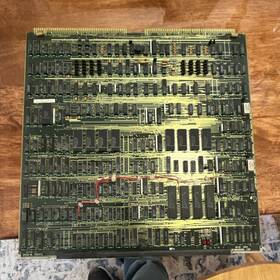
( Brand: Data General ), ( Manufacturer Part Number: IAC2-0 ), ( Part Type: Circuit Board ), ( Mounting Style: Chassis Mount ), ( Pcb Type: Double-sided Pcb ), ( Number Of Tie-points: 128 ), ( Operating Voltage: 12 Vdc ), ( Item Height: 10 Mm ), ( Material: Fr-4 ), ( Item Length: 47.62 Mm ), ( Item Width: 30 Mm )
Review DATA GENERAL Iac2 Series Printed Circuit Board 12vdc Fr-4 Used
The **Data General IAC2-0 IAC2 Printed Circuit Board (F03111, 12VDC, FR-4)** is a meticulously engineered component designed for integration into the IAC2 (Intelligent Array Controller 2) series of data storage systems, originally developed by Data General Corporation in the late 1980s and early 1990s. This high-reliability printed circuit board (PCB) serves as the backbone of the controller s logic and interface circuitry, facilitating seamless communication between the host system and the attached storage arrays, such as disk drives or tape units. Constructed on a **FR-4 glass-reinforced epoxy substrate**, the board is built to withstand rigorous operational demands while maintaining structural integrity under varying environmental conditions, including temperature fluctuations and mechanical stress.
The **F03111 PCB** incorporates a dense arrangement of **surface-mount and through-hole components**, including custom ASICs (Application-Specific Integrated Circuits), discrete logic gates, memory chips, and high-speed interface connectors. Central to its functionality is the **12VDC power supply interface**, which ensures stable operation of the board s active components while adhering to the system s voltage requirements. This board features critical signal routing for **SCSI (Small Computer System Interface) or proprietary Data General bus protocols**, enabling high-speed data transfer between the controller and peripheral devices. The inclusion of **ECL (Emitter-Coupled Logic) or TTL (Transistor-Transistor Logic) circuitry** allows for low-latency signal processing, essential for maintaining optimal performance in high-throughput storage environments.
One of the most distinctive aspects of this PCB is its **modular design**, allowing for easy integration into the IAC2 s chassis while accommodating expansion or upgrades. The board s layout is optimized for **minimal signal skew and crosstalk**, ensuring data integrity across long traces and high-speed pathways. Additionally, the **F03111** includes diagnostic and status LEDs, providing real-time feedback on the system s operational status, which was particularly valuable in enterprise environments where uptime and fault detection were paramount. The board s **gold-plated connectors** and **high-quality soldering** further enhance its durability, reducing the risk of intermittent connections a common issue in older or high-vibration environments.
From a historical perspective, this PCB reflects the technological advancements of its era, bridging the gap between early minicomputer architectures and the rise of modern storage solutions. It was specifically designed to support **Data General s AViiON and Eclipse systems**, which were widely used in business and scientific applications requiring robust, scalable storage solutions. The **IAC2 series** was renowned for its ability to manage large arrays of disk drives with high reliability, and this PCB played a pivotal role in achieving that performance. Today, it remains a sought-after component for vintage computing enthusiasts, archivists, and professionals restoring or repurposing legacy systems, offering a glimpse into the sophisticated engineering of 1980s and 1990s data storage technology.
For collectors, restorers, or technicians working with retro computing setups, the **Data General IAC2-0 IAC2 PCB (F03111)** is not merely a functional part but a tangible piece of computing history. Its precise construction, combined with its role in enabling high-performance storage solutions, makes it a valuable addition to any collection focused on the evolution of data management systems. Whether used in a restored Data General server or as a component for educational demonstrations, this PCB embodies the ingenuity of an era where hardware reliability and expandability were key to unlocking the full potential of early digital infrastructure.
### **Pros and Cons of Buying a Data General IAC2-0 IAC2 Printed Circuit Board (F03111, 12V DC, FR-4)**
#### **Pros**
1. **Compatibility with Legacy Systems** The IAC2-0 board is part of Data General s Eclipse MV/8000 series, a well-known minicomputer architecture from the 1980s. If you are maintaining or restoring a Data General system (such as an Eclipse MV/8000, MV/8000A, or related models), this board is essential for proper operation. Many modern alternatives lack full backward compatibility, making this board a reliable choice for historical computing enthusiasts and businesses still using these systems.
2. **Reliability and Durability** FR-4 is a standard, high-quality printed circuit board material known for its stability, resistance to heat, and long-term performance. The board is designed for industrial use, suggesting it can withstand prolonged operation under controlled conditions.
3. **Availability of Technical Documentation** Data General s documentation (including schematics, manuals, and technical references) is still accessible through archives, libraries, and online communities (e.g., vintage computing forums). This makes troubleshooting and repair easier compared to undocumented or proprietary hardware.
4. **Potential for Repurposing** While primarily used in Data General systems, some components or design principles from this board (e.g., power management, interface logic) may be of interest to hobbyists or engineers working on retrocomputing projects. The 12V DC power requirement is straightforward, making it easier to integrate into custom setups.
5. **Community Support** The vintage computing community has a strong presence for Data General hardware. Users often share restoration tips, spare parts, and compatibility insights, reducing the risk of being stranded without support.
6. **Historical and Collectible Value** For collectors and enthusiasts, owning a fully functional Data General component adds value to a museum-quality or operational vintage computing setup. The rarity of original parts can also make it a desirable piece for those preserving computing history.
---
#### **Cons**
1. **High Cost and Scarcity** Original Data General parts, especially printed circuit boards, are extremely rare and often expensive. The F03111 board may require sourcing from collectors, eBay, or specialized retrocomputing suppliers, which can drive up prices significantly. Reproduction or reverse-engineered versions may not be available, adding to the cost.
2. **Lack of Modern Support** Unlike newer systems, Data General hardware lacks modern software support, driver updates, or community-driven maintenance. If the board fails, finding replacement parts or skilled technicians may be difficult. Most support comes from niche forums or individual experts.
3. **Power and Environmental Requirements** The board operates at 12V DC, which is standard for vintage systems but may require careful power supply management. Overvoltage, undervoltage, or poor grounding can damage the board. Additionally, the board may not be designed for modern environmental conditions (e.g., humidity, temperature fluctuations), potentially shortening its lifespan if not stored properly.
4. **Complexity of Repair** Without original documentation or a fully intact system, diagnosing issues (e.g., faulty capacitors, corroded traces, or failed ICs) can be challenging. Soldering, desoldering, and testing components may require specialized tools and expertise, especially for those unfamiliar with analog or early digital circuitry.
5. **Limited Use Cases Outside Original Systems** Unlike modern PCBs that can be adapted for various projects, the IAC2-0 board is tightly integrated into the Data General architecture. Repurposing it for non-Data General applications would likely require significant modification, defeating its original purpose.
6. **Depreciation Risk** Vintage hardware can depreciate rapidly if demand wanes or if newer alternatives emerge. While collectors may value it, the practical utility for modern applications is limited, making it a speculative purchase unless you have a confirmed need.
---
### **Ending Conclusion**
Buying the **Data General IAC2-0 IAC2 Printed Circuit Board (F03111, 12V DC, FR-4)** is a **highly specialized purchase** with clear advantages for those maintaining or restoring Data General systems. The board s reliability, compatibility, and historical significance make it invaluable in the right context. However, the **high cost, scarcity, lack of modern support, and technical challenges** associated with vintage hardware must be carefully considered.
If you are:- **Restoring or maintaining a Data General Eclipse MV/8000 or related system** and cannot find a replacement, this board is a **necessary investment**.
- **A collector or enthusiast** with the resources to source and preserve vintage computing hardware, it adds value to a collection.
- **Seeking a practical, long-term solution** for modern applications, this board is **not the best choice** due to its niche compatibility.
---
### **Recommendation**
1. **Verify Compatibility** Ensure the board is compatible with your specific Data General model (e.g., MV/8000, MV/8000A) and that no alternatives (e.g., refurbished units, third-party replacements) exist.
2. **Source from Trusted Vendors** Purchase from reputable sellers (e.g., eBay with verified feedback, retrocomputing forums, or specialized suppliers like **Bit Bangers, Retro Computing Store, or Vintage Computer Fair**) to avoid counterfeit or damaged parts.
3. **Budget for Additional Costs** Account for shipping, handling, and potential repair or testing fees. Consider whether the board is worth the price compared to alternative solutions (e.g., emulation, modern alternatives).
4. **Document and Preserve** If acquiring for historical purposes, store the board in a stable environment (cool, dry, low humidity) and document its condition for future reference.
5. **Join Vintage Computing Communities** Engage with forums (e.g., **Vintage Computer Federation, Retro Computing, Data General Users Group**) for advice, troubleshooting, and potential trade-ins or repairs.
6. **Evaluate Long-Term Viability** Ask whether the system will remain operational long-term or if emulation (e.g., **MV8000 emulator projects**) could serve as a lower-cost alternative.
**Final Verdict:**Proceed with purchase **only if** you have a confirmed need for the board in a Data General system and are prepared for the challenges of working with vintage hardware. For most modern or general-purpose use cases, this board is **not recommended** due to its limited applicability.
Details:
With 128 tie-points and dimensions of 47.62mm x 30mm 10mm, it is suitable for various electronic applications requiring a reliable high-quality circuit board solution. This PCB has a 12VDC operating voltage and is made of FR-4 material.
part #: iac20 price
- $900.00
specifications pcbemdev:
- brand: Data General
- mpn: Iac2-0
- part type: Circuit Board
- mounting style: Chassis Mount
- pcb type: Double-sided Pcb
- number of tie-points: 128
- operating voltage: 12 Vdc
- item height: 10 Mm
- material: Fr-4
- item length: 47.62 Mm
- item width: 30 Mm
offer pcbemdev:
- options: Ship-to-home
- started: May 21, 2026
- quantity: 1
- availability: In Stock
- sold: 0
- best offers: True
shipping pcbemdev:
- cost: $6.07
- transit: 5-11 Days
- class: Standard
- service: USPS Ground Advantage
- carrier: USPS
- type: Calculated
seller pcbemdev:
- # reviews: 34
- rating: 100.0%
- city: Washington, Vermont
returns pcbemdev:
- policy: No Returns
general pcbemdev:
- condition: Used
- Electronic Components Semiconductors > Circuit Boards Prototyping > Printed Circuit Boards PCBs
payments pcbemdev:
- wallet: Google-pay
- other
- credit card: Diners-club
Data General IAC2-0 Is Similar To:
- 804432-01 Data Systems Design Pcb Board Rev E (33.1% similar) Data systems design pcb board rev...(October 7th, 2016)
- Acc8k2 Delta Tau Ipb Interface Board Dual Axis Data Systems Circuit (23.8% similar) The item available here is a used delta tau Data systems dual axis IP interface assembly...(March 24th, 2018)
- Rev.2 Xrm-opt Alpha Data I O Module Board 4 Pcs Free Shipping (33.6% similar) I bought this as surplus stock from a major manufacturer and the box may have some writing, dirt, small folds or creases associated with shelf storage. Greenback stock A2607 A4627 A4628. 2 I o module board 4 PCs for sale. The shipping on this item reflects standard ground shipping for the us. I have...(June 18th, 2016)
- Boards Disk Recovery Used Lot Pcb Hard Data 5 Laptops 2.5 Sata (20.3% similar) Lot 5 pcb laptops hard disk boards 5 satay used, for Data recovery details 1 DA54346 DA2110A X1P816 DTF2 2 DA53128 DA1792 M1F726 86A6 3 DA71258 DA28028 XZH943 Dothan 600 XC4X17 379L A9B 2025 used, take apart from broken hard disk, can be good Poe repair or recovery Data from broken hard disk no ...(May 9th, 2015)
- Ca21342-b83x Fujitsu Pcb Board Sata For Data Recovery (29.5% similar) 5/1 20GB pcb: CA21342-B83X for Data recovery. Fujitsu pcb board MHW2120BJ, satay...(May 11th, 2018)
- Gfz-63354en Fanuc Ge Ethernet Board Data Server Operators Manual Gfz-63354en 03 (23.2% similar) Please for pricing. I am always here to offer help...(June 13th, 2016)
- Hm160hi Samsung D 160gb Sata 2 5 Hard Drive Pcb Circuit Board Only For Data (41.1% similar) Samsung HM160HI160GB satay 2,5 hard drive pcb circuit board only for Data...(May 13th, 2016)
- 7.5vdc 761a Starrett Data Collector System Atd06070412 500ma Used (34% similar) The unit comes with serial cables, foot switch and power supply. Works with other major software packages with its standard RS232C output supplied with 4 starred tool modules. Will accept other brands of tools using their standard cables with modules available from starred. Unit is very clean ...(February 26th, 2016)
- Wd5000aajb-00uha0 Western Digital Pcb 3.5 Ide Logic Board For Data Recovery (35.8% similar) 5 ide logic board for Data recovery working pull from a drive that was used for Data recovery purposes. Technical support is readily available to assist you at any time...(August 14th, 2016)
- Delta Tau Data Sys Pmac2-pc Used Control Board 602404-107 602705-107 (40.3% similar) Used delta tau Data says PMAC2-PC control board 602404-107 602705-107, 2038 BB...(August 14th, 2024)
- Barber Colman A-60010-705 Data Handler Pc Board Used Free Shipping (31% similar) With a chassis mount and four tie-points, it is easy to install use. This barber Coleman A-60010-705 Data handler pc board is a reliable and efficient choice for any electronic component needs. This model has a voltage of 3.3V and is ideal for reference number 94297. Buy now and enjoy free ...(August 19th, 2024)