ADVANTECH Motherboard 1PC PCA-6277VE A1
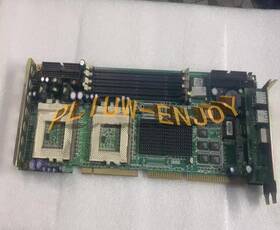
( Brand: Advantech ), ( Manufacturer Part Number: PCA-6277 ), ( Model: PCA-6277 REV ), ( Country Of Origin: China )
Review ADVANTECH 1pc Used Motherboard Rev A1
The **Advantech PCA-6277** is a high-performance, industrial-grade motherboard designed for demanding embedded computing applications, offering a robust and scalable platform for mission-critical systems. Part of Advantech s **PCA-6277VE-A1** series, this board is engineered to deliver exceptional reliability, flexibility, and efficiency in environments where durability and performance are paramount. Built around a **low-power Intel Core i7-8700T processor** (up to 4.1 GHz with Turbo Boost), the PCA-6277 leverages the **LGA1151 socket** to ensure seamless compatibility with the latest Intel architecture while maintaining energy efficiency through its **TDP of 35W**. This makes it an ideal choice for applications requiring balanced processing power without excessive heat or power consumption, such as industrial automation, digital signage, medical imaging, and edge computing deployments.
The motherboard features a **dual-channel DDR4 memory interface**, supporting up to **64GB of ECC (Error-Correcting Code) registered memory** in configurations of 2x32GB or 4x16GB, which enhances data integrity and stability critical for applications handling large datasets or real-time processing. Its **PCIe 3.0 x16 slot** provides high-bandwidth connectivity for graphics cards, accelerators, or high-speed peripherals, while the **PCIe 3.0 x1** slot offers additional flexibility for expansion cards or storage solutions. For connectivity, the PCA-6277 is equipped with a **Gigabit Ethernet port** (Intel I219-LM) and **two USB 3.1 Gen2 ports**, ensuring fast data transfer rates for high-resolution video, storage, or peripheral devices. Additionally, the board includes **four USB 3.0 ports**, **two USB 2.0 ports**, and **HDMI 2.0** and **DisplayPort 1.2** outputs, catering to both professional and consumer-grade display requirements, including 4K UHD resolution support.
Industrial resilience is a cornerstone of the PCA-6277 s design, with a **wide operating temperature range of -25 C to 60 C**, making it suitable for harsh or temperature-varying environments. The board complies with **CE, FCC, and RoHS** standards, ensuring compliance with global regulatory requirements, while its **ATX form factor** (305mm x 244mm) provides ample space for component integration. For storage, the PCA-6277 supports **SATA III (6Gbps)** and **M.2 (Key M) slots**, accommodating high-capacity SSDs or NVMe drives for faster boot times and data access. Security and manageability are further enhanced by **TPM 2.0 support**, **secure boot**, and **IPMI 2.0**, enabling remote monitoring, diagnostics, and firmware updates essential for enterprise and industrial applications where uptime and security are non-negotiable.
The PCA-6277VE-A1 variant includes **VGA output** alongside its HDMI and DisplayPort connectors, broadening its compatibility with legacy and modern displays. Its **fanless or fan-assisted cooling options** (via the included heatsink and optional fan module) allow for silent operation in noise-sensitive environments while maintaining thermal efficiency. Whether deployed in a **kiosk, industrial control system, or high-performance embedded server**, this motherboard delivers a harmonious blend of processing power, connectivity, and industrial robustness, making it a versatile backbone for next-generation computing solutions.
The **Advantech PCA-6277** is an industrial-grade motherboard designed for rugged, embedded, and IoT applications. Below is a detailed breakdown of its pros and cons, followed by a conclusion and recommendation.
---
### **Pros of the Advantech PCA-6277**
1. **Industrial-Grade Reliability**
The PCA-6277 is built for harsh environments, featuring robust components, extended temperature ranges (-40 C to 85 C), and compliance with industrial standards (CE, FCC, UL, etc.). This makes it ideal for applications in manufacturing, automation, transportation, or outdoor deployments where stability is critical.
2. **High Performance CPU Options**
It supports **Intel Celeron/J3/J4 processors** (e.g., J3455, J4125), which offer decent single-core performance for embedded tasks like data processing, control systems, or light computing workloads. The dual-core or quad-core configurations (depending on the CPU) provide sufficient processing power for many industrial applications.
3. **Extensive I/O and Connectivity**
The board includes a rich set of interfaces:- **Expansion slots**: One **PCIe x16** (Gen 3) and one **PCIe x1** (Gen 3), useful for adding accelerators, networking cards, or storage.
- **Serial ports**: Up to **4 COM ports** (RS-232/422/485), essential for legacy industrial equipment or direct sensor interfacing.
- **USB ports**: **4 USB 2.0** and **2 USB 3.0**, supporting peripherals, storage, or HMI devices.
- **Gigabit Ethernet**: Dual **GbE LAN ports** with optional **PoE** (Power over Ethernet) support, enabling networked control systems or IoT deployments.
- **LVDS/HDMI/DisplayPort**: Supports **dual-display output** via LVDS or HDMI, useful for HMI panels or monitoring interfaces.
- **SATA III**: For high-speed storage (SSD/HDD) integration.
- **GPIO and digital I/O**: Useful for custom sensor or actuator control.
4. **Power Efficiency and Redundancy**
The board supports **dual 12V/24V DC power inputs** with **hot-swap capability**, ensuring continuous operation even during power fluctuations or failures. This is critical for mission-critical systems.
5. **Software Support and Flexibility**
- **Windows 10 IoT Enterprise** and **Linux** (Ubuntu, Yocto) support out of the box, making it versatile for different application needs.
- **Advantech s embedded software suite** (e.g., **iManager**, **Web Server**) simplifies remote management and monitoring.
- **Virtualization support** (via Intel VT-x) allows running multiple OS instances or virtual machines for testing or isolated applications.
6. **Compact Form Factor**
The **ATX form factor** (though slightly larger than mini-ITX) balances space efficiency with expandability. It fits into standard industrial chassis while still offering ample connectivity.
7. **Long-Term Availability and Support**
Advantech is a well-established manufacturer with a reputation for **long-term product support**, including availability of components and firmware updates. This reduces the risk of obsolescence compared to consumer-grade hardware.
8. **Security Features**
- **Trusted Platform Module (TPM)** for hardware-based security.
- **Secure Boot** and **UEFI** support to prevent unauthorized OS modifications.
- **Network security** options (e.g., firewall, VLAN support) for IoT deployments.
9. **Compatibility with Advantech s Ecosystem**
The PCA-6277 integrates seamlessly with other Advantech products like **I/O modules, gateways, or edge computing platforms**, making it easier to build scalable industrial solutions.
10. **Cost-Effective for Industrial Use**
While not as cheap as consumer-grade motherboards, its **lifespan, reliability, and support** often justify the higher upfront cost in industrial applications where downtime is costly.
---
### **Cons of the Advantech PCA-6277**
1. **Higher Cost Compared to Consumer Alternatives**
The PCA-6277 is **significantly more expensive** than mainstream consumer motherboards (e.g., Intel NUC, Raspberry Pi, or even some mini-ITX boards). For non-industrial applications, this cost may not be justified.
2. **Limited GPU Capabilities**
The board lacks **dedicated GPU support** (only integrated Intel graphics), which restricts its use in graphics-intensive applications (e.g., real-time video processing, 3D rendering). For such tasks, a board with a discrete GPU (e.g., NVIDIA Jetson) would be better.
3. **No M.2 NVMe Support**
While it has **SATA III**, there is **no M.2 slot for NVMe SSDs**, which could limit storage performance for high-speed data logging or database applications.
4. **Power Consumption**
The **Intel Celeron/J-series CPUs** are power-efficient, but the overall board may consume more power than ultra-low-power alternatives (e.g., Raspberry Pi 4 or BeagleBone). This could impact battery life in portable applications.
5. **Learning Curve for Industrial Deployment**
- **Firmware and BIOS settings** can be complex for users unfamiliar with embedded systems.
- **Driver and software configuration** may require additional effort compared to plug-and-play consumer hardware.
- **Documentation** is thorough but assumes some technical background.
6. **Bulk Purchase Requirements**
Advantech often requires **minimum order quantities (MOQs)** for certain configurations or customizations, which may not be feasible for small-scale projects.
7. **No Built-in Wi-Fi/Bluetooth**
Unlike some modern embedded boards (e.g., Raspberry Pi 4, NVIDIA Jetson), the PCA-6277 **does not include Wi-Fi or Bluetooth**, requiring additional modules if wireless connectivity is needed.
8. **Limited Overclocking Potential**
The **Intel Celeron/J-series CPUs** are locked and do not support overclocking, which may be a drawback for performance-critical applications where tuning is possible on higher-end CPUs.
9. **Physical Size and Heat Management**
- The **ATX form factor** is larger than mini-ITX or SFF (Small Form Factor) options, which may be a constraint in space-limited deployments.
- **Passive cooling** is recommended due to the industrial temperature range, which may limit performance under heavy loads compared to actively cooled consumer boards.
10. **Vendor Lock-In Risks**
While Advantech is reliable, relying on a single vendor for industrial hardware can be a risk if the company discontinues support or parts become unavailable. Diversifying suppliers may be prudent for long-term projects.
---
### **Conclusion**
The **Advantech PCA-6277** is an **excellent choice for industrial, embedded, or IoT applications** where **reliability, ruggedness, and long-term support** are critical. Its **extensive I/O, dual-display support, and power redundancy** make it ideal for:
- **Industrial automation** (PLC replacements, HMI control systems).
- **Transportation and telematics** (vehicles, drones, or remote monitoring).
- **Edge computing** (data processing at the source before cloud upload).
- **Military/aerospace** or **oil/gas** applications where environmental resistance is required.
However, it is **overkill and costly** for:- **Consumer-grade computing** (gaming, general desktop use).
- **Ultra-low-power or battery-operated devices** (consider Raspberry Pi, BeagleBone, or NVIDIA Jetson instead).
- **Graphics-intensive applications** (no dedicated GPU).
- **Budget-conscious hobbyist or small-scale projects** (where consumer-grade mini-ITX or SBCs may suffice).
---
### **Recommendation**
**Buy the Advantech PCA-6277 if:**- You need a **rugged, long-lasting motherboard** for an **industrial or embedded system**.
- Your application requires **extensive I/O (serial, Ethernet, PCIe), dual-display support, or power redundancy**.
- You prioritize **vendor support, certifications (CE, UL), and extended temperature ranges**.
- You are working on a **scalable IoT or edge computing project** where future-proofing is important.
**Avoid the Advantech PCA-6277 if:**- You are on a **tight budget** and can use consumer-grade hardware (e.g., Intel NUC, ASUS Pce-570).
- Your project requires **high-performance GPU acceleration** (consider NVIDIA Jetson or AMD-based SBCs).
- You need **wireless connectivity (Wi-Fi/Bluetooth)** without additional modules.
- Your deployment is **space-constrained** (consider mini-ITX or SFF alternatives like the **GIGABYTE BRIX** or **ASRock Industrial boards**).
**Alternatives to Consider:**- **For industrial but lower-cost:** Advantech **PCA-6211** (mini-ITX) or **ASRock Industrial B-series**.
- **For edge AI/ML:** NVIDIA **Jetson AGX Xavier** or **Intel NUC with GPU**.
- **For
Details:
Shipping time: All custom size items are non-returnable.
part #: pca6277 prices
- $414.40-$568.52
specifications pcbemdev:
- brand: Advantech
- mpn: Pca-6277
- model: Pca-6277 Rev
- country of origin: China
payments pcbemdev:
- wallet: Google-pay
- credit card: Visa
- other
returns pcbemdev:
- method: Money back
- policy: Returns Accepted
- paid by: Buyer
- time: 30 Days
seller pcbemdev:
- # reviews: 61
- city: Perth Amboy, New Jersey
- rating: 97.7%
general pcbemdev:
- condition: Used
- Electronic Components Semiconductors > Circuit Boards Prototyping > Printed Circuit Boards PCBs
shipping pcbemdev:
- cost: $0.00
- transit: 4-10 Days
- type: Fixed
- service: Standard
- class: Standard
offer pcbemdev:
- availability: In Stock
- options: Ship-to-home
- quantity: 4
- best offers: True
- started: February 3, 2026
- sold: 0
Advantech PCA-6277 Is Similar To:
- Pce-5124 Advantech Cpu Bd Rev A1 With Quad Core And 4 Gb Ram Qty 2 (32.5% similar) Advantech CPU Bud Pace 5124 rev a1 with quad core CPU and 4 GB ram DDR2 677 dim CL5 supports lag 775 intel core 2 quad fab MHz processors up to 83GHZ supports up to 8GB DDR2 240 pin dim x 4 one pic express X16 and four x1 to back plane dual gigabit Ethernet via two pic express x1 lanes supports 6 ...(December 16th, 2015)
- Aimb-763vg-00a1e Advantech Motherboard All Accessories Driver Cd Nib (38.4% similar) Brand new in box...(November 10th, 2018)
- Pca-6010 Advantech Industrial Computer Motherboard Circuit Board (43% similar) Advantech PCA-6010 industrial computer motherboard circuit board rev...(December 6th, 2018)
- Pca-6114p7 Advantech Industrial Computer Backplane Circuit Board (29.8% similar) Advantech PCA-6114P7 industrial computer back plane circuit board rev...(December 5th, 2018)
- Pca-6179 Advantech Industrial Computer Motherboard Circuit Board (43% similar) Advantech PCA-6179 industrial computer motherboard circuit board rev...(December 5th, 2018)
- Advantech 1903722000 Pcl-722 144 Channel Digital I o Pcb Card Rev A2 (36.8% similar) Ask our experts. Items in LOT1. Condition used. Model PCL-722. Part number. 6x 50-PIN ribbon cable connectors. And the cost of return shipping. Country of...(December 26th, 2024)
- Advantech 19a6858303 Pcm-9583 Rev.a1 Circuit Board Pcb With Processor Adventach Ark 3400 Motherboard (35.7% similar) ...(January 24th, 2025)
- Advantech Acp-2320 Rev B1 Circuit Board (41.7% similar) Advantech ACP-2320 rev b1 circuit board...(April 7th, 2025)
- Advantech Pca-6184e2 Pci isa Sbc Single Board Computer Pcb Card Pca-6184 Working (52.6% similar) Hard disk: none. Item condition: working, 90 day warranty. Processor: undetermined. Part no: PCA-6184E2. Serial numbers or country of manufacture may vary. The physical condition is good, but there are signs of previous use and handling. Only items pictured are included: if a part is not pictured, ...(May 5th, 2025)
- Advantech 19a6021402-02 Aimb-214 Rev A1 01 Motherboard (45% similar) Ryan MRI sells factory new and pre-owned surplus products develops channels to purchase such product. Manufacturer part number: 19A6021402-02, AIMB-214, rev: A1...(September 4th, 2025)
- Advantech Pos-760 1907076005 Circuit Board Rev.a3 (47.2% similar) Part #: Advantech POS-760 for sale...(September 19th, 2025)