STMICROELECTRONICS STEVAL-PCC009V2 Ibu Interface Evaluation STM32 Board
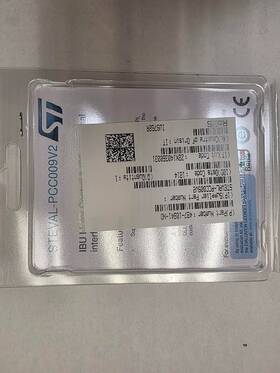
( Brand: Stmicroelectronics ), ( Manufacturer Part Number: STEVAL-PCC009V2 ), ( Part Type: Board )
Review STMICROELECTRONICS Ibu Interface Evaluation Board
The **STMicroelectronics STEVAL-PCC009V2** is a comprehensive evaluation board designed to simplify the development and prototyping of **STM32 microcontrollers (MCUs) with integrated In-Circuit Debugging (ICD) and In-Application Programming (IAP) capabilities** through the **STM32 Interface Board Unit (IBU)**. This versatile platform serves as an ideal starting point for engineers and developers looking to explore the full potential of STM32 s advanced microcontroller ecosystem, particularly those featuring ARM Cortex-M cores. The board is meticulously engineered to provide a seamless integration of the STM32 MCU with essential peripherals, including a **USB interface, JTAG/SWD debugging ports, and a robust power management system**, all while maintaining a compact and modular design. At its core, the STEVAL-PCC009V2 supports a wide range of STM32 MCUs, including those with **Cortex-M0, M0 , M3, M4, or M7** architectures, making it a highly adaptable tool for applications spanning embedded systems, industrial automation, IoT devices, and more. The evaluation board features a **highly integrated circuit layout**, complete with user-friendly indicators such as LEDs for real-time status monitoring, push buttons for interactive control, and a **128x64 pixel OLED display** for graphical output, enabling developers to quickly validate and demonstrate their firmware logic. Additionally, the board incorporates a **USB-to-serial converter**, allowing for seamless communication with host systems via virtual COM ports (VCP), which simplifies debugging and data logging processes. The power subsystem is equally robust, offering flexible voltage regulation options to accommodate various STM32 MCU power requirements, with support for both single-supply and dual-supply configurations. This ensures compatibility with a broad spectrum of applications, from low-power battery-operated devices to high-performance systems demanding sustained processing power. For developers seeking to accelerate their prototyping workflow, the STEVAL-PCC009V2 includes **pre-configured firmware examples** and **STSW-STM32091**, STMicroelectronics comprehensive software development package, which provides access to a library of drivers, middleware, and application notes tailored for STM32 MCUs. This integration streamlines the development cycle, reducing the time required to bring innovative projects to life. Whether used for educational purposes, rapid prototyping, or in-depth hardware validation, the STEVAL-PCC009V2 stands out as a **powerful, all-in-one solution** that bridges the gap between theoretical concepts and practical implementation, empowering engineers to harness the full capabilities of STM32 s cutting-edge microcontroller technology.
The **STMicroelectronics STEVAL-PCC009V2** is an evaluation board designed for the **STM32 IBU (Intelligent Battery Unit)** interface, enabling development of battery management systems (BMS) for electric vehicles (EVs) and other high-power applications. Below is a detailed analysis of its pros and cons, followed by a conclusion and recommendation.
---
### **Pros of the STEVAL-PCC009V2**
1. **STM32 MCU Integration**
The board is built around an **STM32 microcontroller**, specifically designed for high-performance, real-time control tasks. This provides a robust platform for implementing advanced BMS algorithms, such as cell balancing, state-of-charge (SoC) estimation, and fault detection.
2. **IBU Interface Support**
The board features the **IBU (Intelligent Battery Unit) protocol**, which is optimized for high-speed communication between the BMS and battery cells. This is particularly useful in EV applications where low-latency and reliable data transfer are critical. The IBU protocol also supports **multi-cell communication**, allowing for scalable battery pack designs.
3. **Dedicated Hardware for Battery Monitoring**
The board includes **high-precision analog front-end (AFE) components** for measuring cell voltages, currents, and temperatures. This simplifies the design of a BMS by providing pre-integrated sensors and signal conditioning, reducing the need for external components.
4. **Flexibility and Extensibility**
The board is designed to be modular, allowing developers to integrate additional sensors, communication interfaces (e.g., CAN, LIN, or Ethernet), or power stages as needed. This makes it suitable for both prototyping and production-level development.
5. **Documentation and Software Support**
STMicroelectronics provides comprehensive documentation, including reference manuals, code examples, and middleware libraries (e.g., for IBU communication and BMS algorithms). This accelerates development by reducing the need for low-level implementation from scratch.
6. **Power Efficiency**
The STM32 MCU family used in this board is known for its low-power operation, which is beneficial for battery-powered applications where energy efficiency is a priority. This can extend the operational life of the BMS itself.
7. **Compatibility with ST s Ecosystem**
The board is part of ST s broader ecosystem, which includes development tools like **STM32CubeIDE**, **STM32CubeMX**, and **X-CUBE-BMS** (a middleware for battery management). This integration simplifies firmware development and debugging.
8. **Suitable for High-Voltage Applications**
The board is designed to handle the voltage and current levels typical in EV battery packs, making it a practical choice for automotive and industrial applications.
9. **Cost-Effective for Prototyping**
While not a production-ready board, it offers a cost-effective way to validate BMS concepts before committing to custom hardware design.
---
### **Cons of the STEVAL-PCC009V2**
1. **Limited to Prototyping**
The board is an **evaluation tool** and not optimized for mass production. It lacks features such as **ruggedized packaging, high-reliability components, or automotive-grade certification** (e.g., AEC-Q100). For production, a custom PCB with qualified components would be necessary.
2. **No Built-in High-Voltage Isolation**
High-voltage battery systems (e.g., 400V in EVs) require **galvanic isolation** between the BMS and the battery pack for safety. The STEVAL-PCC009V2 does not include isolation components, which must be added externally, increasing complexity and cost.
3. **Dependence on ST s Software Stack**
While ST provides middleware, developers may still need to customize or extend the software for their specific use case. This could require additional time and expertise, especially for advanced BMS features like machine learning-based SoC estimation.
4. **Limited Scalability for Large Packs**
The board is designed for **smaller battery packs or single-cell testing**. For very large packs (e.g., 100 cells), the IBU protocol and MCU may need to be scaled up, which could require additional hardware or software modifications.
5. **No Built-in Charging Management**
The board focuses on **battery monitoring and cell balancing** but does not include **charging control logic** (e.g., for fast charging or bidirectional power flow in EVs). Additional components or protocols (e.g., SAE J1772, GB/T 20234) would need to be integrated separately.
6. **Learning Curve for IBU Protocol**
The **IBU protocol** is not as widely adopted as other communication standards (e.g., CAN, LIN, or I2C). Developers unfamiliar with IBU may need to invest time in learning its implementation details, including timing, error handling, and multi-master communication.
7. **No Built-in Safety Features**
Production-grade BMS systems require **hardware-level safety features** such as overcurrent protection, overvoltage protection, and thermal shutdowns. The evaluation board lacks these safeguards, which must be designed into the final system.
8. **Limited Community and Third-Party Support**
Compared to more mainstream microcontrollers (e.g., ARM Cortex-M based boards from NXP or TI), the STM32 IBU evaluation board has a **smaller community and fewer third-party libraries or examples**. This could make troubleshooting or finding solutions to specific problems more challenging.
9. **Cost of Additional Components**
While the board itself is reasonably priced, developing a full BMS around it may require purchasing **additional sensors, communication modules, or power stages**, increasing the overall cost.
10. **No Built-in Wireless Communication**
For remote monitoring or over-the-air (OTA) updates, developers would need to add **Wi-Fi, Bluetooth, or cellular modules** separately, adding complexity to the design.
---
### **Conclusion**
The **STEVAL-PCC009V2** is an excellent **prototyping tool** for developers looking to explore **STM32-based BMS solutions** with the **IBU protocol**. It provides a solid foundation for testing battery monitoring algorithms, cell balancing, and communication between the BMS and battery cells. The board s strengths lie in its **integration of high-precision analog components, STM32 MCU performance, and ST s software ecosystem**, which significantly reduce development time for early-stage projects.
However, it is **not suitable for production** due to its lack of **isolation, safety certifications, and ruggedized design**. Developers must account for these limitations when transitioning from prototyping to a final product. Additionally, the **IBU protocol s niche adoption** and the board s **limited scalability** may pose challenges for large-scale or automotive-grade applications.
For **academic research, small-scale BMS development, or validation of BMS algorithms**, the STEVAL-PCC009V2 is a **highly recommended starting point**. For **production-ready systems**, especially in automotive or industrial applications, a **custom PCB with isolated components, safety certifications, and additional features** would be necessary.
---
### **Recommendation**
1. **Use the STEVAL-PCC009V2 for:**- Prototyping **STM32-based BMS** with IBU communication.
- Testing **cell balancing algorithms, SoC estimation, and fault detection**.
- Validating **high-speed data acquisition and processing** for battery monitoring.
- Learning the **IBU protocol** and integrating it with other communication interfaces (e.g., CAN for vehicle integration).
2. **Avoid using the STEVAL-PCC009V2 for:**- **Production-grade BMS** without additional hardware modifications.
- **High-voltage automotive applications** without adding isolation and safety features.
- **Large-scale battery packs** (e.g., 100 cells) without scaling the IBU network.
- **Systems requiring wireless communication or OTA updates** without external modules.
3. **Next Steps After Prototyping:** - If the prototype is successful, **design a custom PCB** with:- **Galvanic isolation** (e.g., using optocouplers or digital isolators).
- **Automotive-grade components** (e.g., AEC-Q100 certified ICs).
- **Additional safety features** (e.g., overcurrent, overvoltage, and thermal protection).
- **Certifications** (e.g., ISO 26262 for automotive, UL 1973 for EV batteries).
- Consider **supplementing the STM32 with additional MCUs** (e.g., for charging control or wireless communication).
- Explore **alternative communication protocols** (e.g., CAN FD, Ethernet) if IBU proves limiting for scalability.
4. **Alternatives to Consider:**- For **CAN-based BMS**, evaluate boards like **NXP s FRDM-K64F** or **TI s LaunchPad with MSP430**.
- For **highly integrated BMS solutions**, look into **dedicated BMS ICs** from companies like **Texas Instruments (e.g., bq76PL455A)** or **Analog Devices (e.g., ADuCM3029)**.
- For **EV-specific applications**, consider **automotive-grade BMS solutions** from **ST, Infineon, or Renesas**, which may include built-in safety and certification support.
In summary, the **STEVAL-PCC009V2 is a valuable tool for B
Details:
Manufactured by STMicroelectronics, a trusted brand in semiconductors, this board provides reliable platform for testing and prototyping electronic circuits. The STMicroelectronics STEVAL-PCC009V2 STM32 - IBU Interface Evaluation Board is a high-quality circuit board designed for evaluating the interface capabilities of micro controllers. With its specific model number and focus on interface evaluation, this product is ideal for businesses industrial applications looking to enhance their electronic setups with STM32 technology.
part #: stevalpcc009v2 prices
- $9.76-$27.98
specifications pcbemdev:
- brand: Stmicroelectronics
- mpn: Steval-pcc009v2
- part type: Board
seller pcbemdev:
- # reviews: 55
- city: Menlo Park, California
- rating: 100.0%
shipping pcbemdev:
- service: FedEx Ground Economy, USPS Ground Advantage, UPS Ground
- type: Fixed
- transit: 4-10 Days
- cost: $0.00
- carrier: FedEx, USPS, UPS
- class: Economy, Standard
returns pcbemdev:
- policy: No Returns
general pcbemdev:
- condition: Used
- Electronic Components Semiconductors > Circuit Boards Prototyping > Printed Circuit Boards PCBs
offer pcbemdev:
- best offers: True
- availability: In Stock
- options: Ship-to-home
- quantity: 2
- sold: 0
- started: April 28, 2026
payments pcbemdev:
- other
- wallet: Google-pay
- credit card: Visa
Stmicroelectronics STEVAL-PCC009V2 Is Similar To:
- Steval-ill016u2 N A New In Box Stmicroelectronics 15w Offline Triac Prototype Board (39.7% similar) The items shown in the photos are what is included in the offer. All of our offers include notes on the condition of the item. If you require a specific carrier, please in advance. Your satisfaction is our highest priority. If an offer says as is or for parts or repair the item is believed not to be...(August 3rd, 2016)
- Stm3240g-eval Stmicroelectronics St Microelectronics Stm32f407 I2c Eval Board (57.3% similar) It comes with all accessories and cables, European power adapter. This item sold at dickey or mouser for 334 each. My project requires a different device, and therefore I no longer want it. I have a st micro STM32F407 evaluation board that never been used...(May 21st, 2016)