ZHONGYI ZY-206 Breadboard Tie Points 2390 6-ROW 0-15V
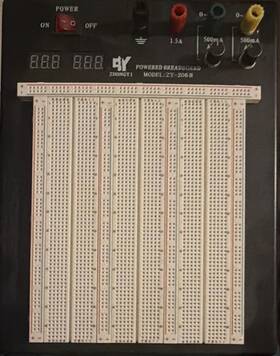
( Brand: Zhongyi ), ( Manufacturer Part Number: ZY-206 ), ( Mounting Style: Stand Alone ), ( Pcb Type: Double-sided Pcb ), ( Material: Plastic ), ( Item Length: 31.75 Mm ), ( Type: Powered Breadboard ), ( Number Of Tie-points: 2390 ), ( Operating Voltage: 0-15 V ), ( Item Height: 9 Mm ), ( Item Width: 22.9 Mm )
Review ZHONGYI Powered Breadboard2390 Tie points 6-row
The **Zhongyi ZY-206 Breadboard** is a versatile and high-quality prototyping tool designed to streamline the assembly and testing of electronic circuits with precision and ease. Featuring a **2390-tie-point layout**, this breadboard provides ample space for even the most complex projects, accommodating a wide range of components such as resistors, capacitors, integrated circuits (ICs), transistors, and sensors without the need for soldering. The **6-row design** offers a generous width of 530mm (21 inches) and a depth of 280mm (11 inches), making it ideal for both small-scale experiments and larger-scale developments. Each tie-point is meticulously arranged in a grid pattern, ensuring reliable and consistent connections with minimal resistance, which is critical for accurate signal integrity and power distribution. The breadboard is constructed from high-quality **double-sided, copper-clad phenolic material**, ensuring durability and excellent conductivity, while the sturdy plastic housing provides structural stability to prevent warping or bending during use. With a **voltage rating of 0-15V**, it safely accommodates low to moderate voltage applications, making it suitable for Arduino, Raspberry Pi, and other microcontroller-based projects, as well as analog circuit testing. The clean, modular design allows for easy rearrangement of components, reducing downtime and simplifying iterative prototyping. Whether you're a hobbyist refining a new invention, a student learning the fundamentals of electronics, or a professional troubleshooting a circuit, the ZY-206 breadboard delivers the reliability and flexibility needed to bring ideas to life efficiently. Its combination of spaciousness, precision engineering, and compatibility with a broad range of components makes it an indispensable tool for anyone serious about electronics experimentation.
### **Pros and Cons of buying a Zhongyi ZY-206 Breadboard (2390 Tie-Points, 6-Row, 0-15V)**
#### **Pros:**1. **High Tie-Point Count (2390)** Offers ample space for complex circuits, reducing the need for multiple breadboards or jumpers. This is particularly useful for prototyping large projects like microcontroller setups, signal processing, or power distribution circuits.
2. **Wide Voltage Range (0-15V)** Supports a broad range of power supply voltages, making it versatile for different applications, including Arduino, Raspberry Pi, and other low-to-medium voltage projects. It can also accommodate small motor drivers or sensor circuits without requiring additional voltage regulation.
3. **Durable Construction** Zhongyi breadboards are generally known for their sturdy plastic material, which resists warping and provides reliable contact points. The solderless design ensures easy component placement and modification.
4. **Standardized Layout** The 6-row design follows common breadboard standards, making it compatible with most breadboard-friendly components, modules, and shields. This ensures ease of integration with existing projects.
5. **Cost-Effective for Serious Hobbyists/Students** While not the cheapest option, the 2390 tie-points justify the price for users who frequently work on large or multi-component projects. It reduces long-term costs by minimizing the need for additional breadboards or messy wiring.
6. **Good Contact Quality** Zhongyi breadboards are reputed for their clean, well-aligned holes, which reduce the risk of loose connections a common issue with cheaper alternatives.
7. **Space Efficiency** The compact yet dense layout maximizes usable area, allowing for more components in a smaller footprint compared to smaller breadboards.
---
#### **Cons:**1. **Overkill for Simple Projects** If you re working on basic circuits (e.g., LED blinkers, simple resistor-divider setups, or small sensor circuits), a smaller breadboard (e.g., 400-830 tie-points) would suffice. The extra space may go unused, making it a less cost-effective choice for minimalist projects.
2. **Bulkier and Less Portable** Due to its size, it s heavier and less convenient to carry around compared to smaller breadboards. This could be a drawback for field testing or on-the-go prototyping.
3. **Potential for Overcrowding** While 2390 tie-points are generous, poorly organized wiring can still lead to tangled jumpers and reduced readability. Users must develop disciplined wiring habits to avoid clutter.
4. **Price Point** At a higher cost than standard breadboards, it may not be justified for casual users or those on a tight budget. The investment is better suited for long-term or professional use.
5. **Limited Vertical Space** The 6-row design means fewer vertical connections per column compared to taller breadboards (e.g., 8- or 10-row). Deep or vertically complex circuits may require additional jumpers or external connections.
6. **Quality Variability** While Zhongyi is a reputable brand, lower-quality counterfeit or third-party versions may exist. Always verify the seller s authenticity to avoid poor contact reliability or flimsy construction.
7. **Learning Curve for Beginners** The sheer size can be overwhelming for novices. Smaller breadboards are often recommended for beginners to build foundational skills before scaling up.
---
### **Conclusion:**The **Zhongyi ZY-206 breadboard is an excellent choice for hobbyists, students, and professionals who frequently work on large, complex, or power-sensitive circuits**. Its high tie-point count, wide voltage compatibility, and durable build make it ideal for projects involving microcontrollers, sensors, motor drivers, or signal processing. However, it may not be necessary or cost-effective for simple, low-component projects.
For **casual users, beginners, or those working on small-scale circuits**, a smaller breadboard (e.g., 400-830 tie-points) would be more practical. The ZY-206 s advantages are best realized by users who prioritize flexibility, long-term use, and the ability to handle larger designs without frequent breadboard switching.
---
### **Recommendation:** - **Buy it if:**- You frequently prototype large circuits (e.g., Arduino/Raspberry Pi projects with many sensors, shields, or power components).
- You work with voltage-sensitive or high-current applications (within its 0-15V limit).
- You want a durable, long-term investment that reduces the need for multiple breadboards.
- You re comfortable with slightly higher upfront costs for greater convenience.
- **Avoid it if:**- You re a beginner or work on very simple circuits.
- You prioritize portability or minimalism.
- You re on a tight budget and can manage with a smaller, cheaper breadboard.
- Your projects rarely exceed 400-800 tie-points.
**Final Verdict:** The Zhongyi ZY-206 is a **high-quality, versatile breadboard** that excels for advanced users but may be unnecessary for basic experimentation. Always pair it with good wiring practices to maximize its potential.
Details:
Only cable included is the power.
part #: zy206 price
- $22.49
specifications pcbemdev:
- brand: Zhongyi
- mpn: Zy-206
- mounting style: Stand Alone
- pcb type: Double-sided Pcb
- material: Plastic
- item length: 31.75 Mm
- type: Powered Breadboard
- number of tie-points: 2390
- operating voltage: 0-15 V
- item height: 9 Mm
- item width: 22.9 Mm
shipping pcbemdev:
- carrier: USPS
- transit: 6-10 Days
- cost: $10.69
- service: USPS Ground Advantage
- type: Calculated
- class: Standard
payments pcbemdev:
- other
- wallet: Google-pay
- credit card: Visa
seller pcbemdev:
- rating: 100.0%
- city: Lake Mary, Florida
- # reviews: 13
returns pcbemdev:
- policy: No Returns
general pcbemdev:
- condition: Used
- Electronic Components Semiconductors > Circuit Boards Prototyping > Breadboards Pinboards
offer pcbemdev:
- availability: In Stock
- best offers: True
- quantity: 1
- started: May 23, 2026
- sold: 0
- options: Ship-to-home