XILINX 1281021 Rfmc Balun Transformer Card HW-FMC-XM500
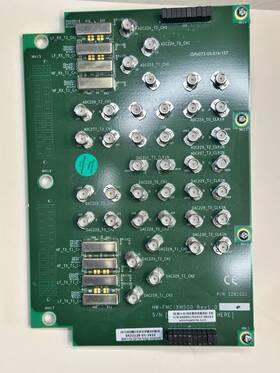
( Brand: Xilinx ), ( Manufacturer Part Number: 1281021 ), ( Part Type: Card ), ( Mounting Style: Panel Mount ), ( Pcb Type: Double-sided Pcb ), ( Series: Hw-fmc-xm500 ), ( Number Of Tie-points: 36 ), ( Material: Fr-4, Copper )
Review XILINX Rfmc Balun Transformer Add on Card
The **Xilinx 1281021 HW-FMC-XM500 RFMC Balun Transformer Add-On Card** is a high-performance, precision-engineered accessory designed to enhance the signal integrity and flexibility of Xilinx RFSoC (Radio Frequency System-on-Chip) platforms, particularly those utilizing the FMC (FPGA Mezzanine Card) interface. This compact yet robust add-on card integrates a sophisticated **balun transformer module**, specifically tailored for the Xilinx XM500 RFMC (Radio Frequency Mezzanine Card) standard, enabling seamless integration with RFSoC devices like the Xilinx RFSoC ZU or ZU10DR platforms. The balun transformer, a critical component in RF systems, facilitates the conversion between differential and single-ended signals while maintaining impedance matching, minimizing signal reflections, and preserving signal fidelity across a wide frequency spectrum typically spanning from **DC to 6 GHz or higher**, depending on the specific application requirements. Built with **high-precision, low-loss materials**, the balun ensures optimal performance for demanding RF applications such as software-defined radio (SDR), cognitive radio, radar systems, and advanced wireless communication protocols like 5G, LTE, or satellite communications.
The HW-FMC-XM500 card is engineered with **rigorous attention to electromagnetic compatibility (EMC) and signal integrity**, featuring a **low-inductance, high-isolation design** that mitigates crosstalk and ensures stable operation in noisy environments. Its **FMC-compliant interface** allows for straightforward integration with Xilinx s RFSoC platforms, providing direct access to the high-speed ADCs and DACs via the card s **RF connectors**, which are typically **SMA or RF micro-D connectors**, depending on the variant. The card s **modular and scalable architecture** makes it an ideal solution for prototyping and development, as it can be easily swapped between different RFSoC-based systems without requiring significant redesign. Additionally, the HW-FMC-XM500 is constructed with **high-reliability components**, including **surface-mount technology (SMT) resistors, capacitors, and inductors**, ensuring durability and consistency across extended operational lifespans.
For engineers and designers working on **high-speed data acquisition, digital signal processing (DSP), or RF front-end applications**, this add-on card serves as a versatile tool to bridge the gap between digital and analog domains with minimal signal degradation. Whether used for **wideband signal generation, spectrum analysis, or advanced modulation techniques**, the balun transformer within the HW-FMC-XM500 ensures that critical RF signals are transmitted and received with **maximized efficiency and accuracy**. The card s **comprehensive documentation**, including schematic diagrams, PCB layout details, and integration guidelines, further simplifies the development process, allowing engineers to focus on optimizing their RF system architectures rather than troubleshooting connectivity issues. Ultimately, the **Xilinx 1281021 HW-FMC-XM500 RFMC Balun Transformer Add-On Card** represents a pivotal component for next-generation RF innovation, empowering developers to push the boundaries of wireless communication technology with confidence.
### **Pros and Cons of buying a Xilinx 1281021 (HW-FMC-XM500 RFMC Balun Transformer Add-On Card)**
#### **Pros**
1. **Enhanced RF Performance** The add-on card improves signal integrity by providing balanced-to-unbalanced (balun) conversion, reducing common-mode noise and improving impedance matching in RF applications. This is particularly useful for high-frequency signal processing, such as radar, communications, or test-and-measurement systems.
2. **Compatibility with Xilinx FPGA Platforms** Designed specifically for Xilinx FPGA-based systems (e.g., Zynq, RFSoC, or other FPGA modules with FMC connectors), ensuring seamless integration without additional hardware modifications.
3. **Supports High-Frequency Applications** The XM500 balun transformer is optimized for RF signals up to **500 MHz**, making it suitable for applications like software-defined radio (SDR), wireless communication prototyping, and RF front-end testing.
4. **Modular and Scalable** The FMC (FPGA Mezzanine Card) form factor allows for easy integration into existing FPGA-based systems, enabling users to upgrade or modify RF capabilities without redesigning the entire board.
5. **Reduced Design Complexity** By offloading balun functionality to a dedicated card, engineers can simplify their FPGA design, focusing on core algorithmic and processing tasks rather than RF signal conditioning.
6. **Commercial-Grade Reliability** As a product from Xilinx (now part of AMD), the card is built to commercial standards, offering durability and long-term availability, which is critical for production or research environments.
7. **Flexibility for Prototyping** Useful for rapid prototyping of RF systems, allowing developers to test different balun configurations or RF front-end designs before committing to custom PCB layouts.
8. **Documentation and Support** Xilinx provides technical documentation, reference designs, and customer support, which can be invaluable for troubleshooting or optimizing performance.
---
#### **Cons**
1. **Limited Frequency Range** The card is optimized for **up to 500 MHz**, which may be insufficient for applications requiring higher frequencies (e.g., microwave or millimeter-wave systems). Users targeting GHz-range applications may need additional or alternative solutions.
2. **Cost** As a specialized add-on card, the **HW-FMC-XM500** is not a low-cost component. For budget-conscious projects, especially in academia or small-scale development, the expense may be prohibitive compared to designing a custom balun solution.
3. **Single-Purpose Functionality** The card is designed solely for balun conversion and does not include additional RF components (e.g., amplifiers, filters, or mixers). Users may still need to pair it with other modules or external circuitry for complete RF functionality.
4. **FMC Connector Dependency** The card requires an FMC-compatible FPGA board, which may not be available in all systems. Users without an FMC slot or compatible FPGA platform will need to invest in additional hardware.
5. **Signal Loss and Insertion Loss** Like all baluns, the XM500 introduces some insertion loss and potential signal attenuation, which may impact sensitivity in low-power applications. Users must account for this in their system design.
6. **Limited Customization** The balun characteristics (e.g., impedance ratio, bandwidth) are fixed by the card s design. For highly specialized applications, a custom balun may be necessary, eliminating the flexibility of this add-on.
7. **Power Requirements** The card may require additional power (e.g., via the FMC connector or external supply), adding complexity to the power distribution in the system.
8. **Deprecation Risk** While Xilinx (now AMD) maintains support for many products, there is a risk that this card may eventually be discontinued or replaced by newer technologies (e.g., integrated RF solutions in FPGAs like RFSoC). Users should consider long-term availability.
---
### **Conclusion**
The **Xilinx HW-FMC-XM500 RFMC Balun Transformer Add-On Card** is a **high-quality, modular solution** for RF applications requiring balanced-to-unbalanced conversion up to **500 MHz**. It excels in **FPGA-based RF prototyping, signal integrity improvement, and reducing design complexity** for engineers working with Xilinx platforms. However, its **limited frequency range, cost, and dependency on FMC-compatible hardware** may make it less ideal for high-frequency or budget-sensitive projects.
For users with **Xilinx FPGA systems needing a reliable, off-the-shelf balun solution**, this card is a strong choice. For those requiring **higher frequencies, customization, or lower costs**, alternatives such as **custom balun designs, integrated RF solutions (e.g., RFSoC), or third-party RF modules** may be more appropriate.
### **Recommendation**
- **Buy the HW-FMC-XM500 if:**- You are working with **Xilinx FPGA platforms** (e.g., Zynq, RFSoC) and need a **quick, reliable balun solution** for **up to 500 MHz**.
- Your project benefits from **modularity and reduced RF design complexity**.
- You prioritize **commercial-grade reliability and support** over absolute cost savings.
- **Consider alternatives if:**- Your application requires **frequencies beyond 500 MHz** (e.g., microwave or millimeter-wave).
- You are working with **non-Xilinx FPGA platforms** without FMC support.
- Budget constraints make the card s cost prohibitive, and a **custom or lower-cost balun solution** is feasible.
- You need **additional RF functionality** (e.g., amplification, filtering) that this card does not provide.
For most **RF prototyping or production systems** where compatibility with Xilinx FPGAs is a priority, the **HW-FMC-XM500 remains a practical and efficient choice**. However, thorough system requirements analysis is essential to ensure it aligns with the intended application.
Details:
Key Feature: It optimizes AC signals and enables impedance transformation between balanced loads coaxial cables using onboard balun transformers. Xilinx HW-FMC-XM500 RFMC Balun Transformer Add-On Card. Components: The board features multiple SMA connectors for signal I/O and on-board balun transformers conditioning. Applications: RF signal analysis and loop back evaluation.
Technical Details: Part Number: 1281021. Evaluating RF signal chains using external equipment via SMA connectors. Technology: The card acts as a differential breakout for Sync Ultra Scale RFC evaluation boards, routing RF-ADC and RF-Daces to RF connectors. This is a Xilinx HW-FMC-XM500 Rev 1.0 RFMC RF Mezzanine Card balun transformer add-on board.
Function: It is a high-performance card designed for signal analysis and loop back evaluation RF applications. Key Features and Use Cases, Purpose: It is designed as an accessory for the ZCU111 evaluation board, facilitating testing development of integrated RF-ADC Analog-to-Digital Converter RF-DAC Digital-to-Analog functionalities within Xilinx Sync Ultra Scale RFC devices.
part #: 1281021 price
- $368.00
specifications pcbemdev:
- brand: Xilinx
- mpn: 1281021
- part type: Card
- mounting style: Panel Mount
- pcb type: Double-sided Pcb
- series: Hw-fmc-xm500
- number of tie-points: 36
- material: Fr-4, Copper
shipping pcbemdev:
- class: Standard
- transit: 3-9 Days
- type: Calculated
- service: USPS Ground Advantage
- carrier: USPS
- cost: $5.39
offer pcbemdev:
- availability: In Stock
- started: April 7, 2026
- sold: 0
- quantity: 1
- options: Ship-to-home
general pcbemdev:
- Electronic Components Semiconductors > Circuit Boards Prototyping > Printed Circuit Boards PCBs
- condition: Used
returns pcbemdev:
- policy: No Returns
payments pcbemdev:
- credit card: Visa
- money order
- other
- wallet: Apple-pay
seller pcbemdev:
- city: Burnsville, Minnesota
- rating: 100.0%
- # reviews: 208
Xilinx 1281021 Is Similar To:
- Esi 87731 Cka Rev B Pci Mmb Interface Card Module Board Xilinx Xc4010e Nip (15.9% similar) Packaging may have wear from storage. See photos for more detail. Includes only what is pictured. ESI CA 87731 rev b prim b interface card module board - Xilinx XC4010E nip, brand new, unused item in original sealed anti-static bag...(January 3rd, 2025)
- Xilinx Hw-ams-101 431749-01 Ams Evaluation Card Cte003 (44.8% similar) See pictures for details. Xilinx HW-AMS-101 431749-01 AM's evaluation card CTE003 nice condition...(April 26th, 2026)