XILINX HW-AMS-101 Evaluation Card Ams 431749-01 CTE003
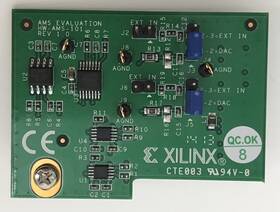
( Brand: Xilinx ), ( Manufacturer Part Number: HW-AMS-101 ), ( Part Type: Card ), ( Country Of Origin: Taiwan )
Review XILINX Ams Evaluation Card
The **Xilinx HW-AMS-101 (Part Number: 431749-01, CTE003)** is a specialized Analog Mixed-Signal (AMS) evaluation card designed to empower engineers and developers working with high-performance analog and RF (radio frequency) circuits integrated into Xilinx FPGA-based systems. This versatile evaluation platform serves as a bridge between digital signal processing (DSP) and real-world analog signals, enabling seamless experimentation with analog front-end (AFE) designs, sensor interfaces, and RF transceivers. Built around Xilinx s advanced FPGA architectures, the HW-AMS-101 leverages the company s proprietary **Analog-to-Digital Converters (ADCs), Digital-to-Analog Converters (DACs), and high-speed serial transceivers**, all of which are tightly integrated with the FPGA fabric to deliver unparalleled flexibility and efficiency. The card features a modular and well-documented design, making it ideal for prototyping applications such as **wireless communication systems, industrial sensing, medical imaging, and automotive radar**, where precise analog signal processing is critical. Its compact yet robust form factor ensures compatibility with standard FPGA development boards, while the inclusion of **high-precision analog components, low-noise amplifiers, and configurable filters** allows users to evaluate complex signal chains without the need for extensive external hardware. Whether testing **delta-sigma ADCs for audio applications, high-speed DACs for RF modulation, or mixed-signal interfaces for IoT sensors**, the HW-AMS-101 provides a turnkey solution that accelerates innovation by reducing prototyping time and minimizing design risks. Additionally, the card is fully supported by Xilinx s comprehensive **software tools, including Vivado Design Suite and Analog Design Suite**, which offer simulation, synthesis, and debugging capabilities to ensure seamless integration with FPGA-based digital logic. For researchers, educators, and engineers alike, the HW-AMS-101 represents a powerful platform for exploring the intersection of digital and analog domains, enabling the development of next-generation mixed-signal systems with confidence.
### **Pros and Cons of buying a Xilinx HW-AMS-101 (Part #431749-01, AMS Evaluation Card CTE003)**
#### **Pros**
1. **Specialized for Analog and Mixed-Signal Applications**
The HW-AMS-101 is designed specifically for analog and mixed-signal (AMS) development, making it ideal for applications requiring high-precision analog processing, sensor interfacing, or RF signal conditioning. Unlike general-purpose FPGA boards, it includes dedicated analog resources (e.g., ADCs, DACs, high-speed I/O) that simplify prototyping in these domains.
2. **Integrated Analog Subsystems**
The board features integrated analog components such as:- **High-speed ADCs/DACs** (e.g., XADC for on-chip analog monitoring or external sensor interfacing).
- **High-performance analog I/O** (e.g., LVDS, differential pairs) for low-noise signal acquisition.
- **Precision voltage references and amplifiers**, which are useful for sensor signal conditioning or RF applications.
This reduces the need for external analog circuitry, saving cost and board space in a prototype.
3. **Compatibility with Xilinx AMS IP Cores**
The board is optimized for Xilinx s AMS IP cores (e.g., **RFSoC IP, ADC/DAC controllers, PLL generators**), allowing seamless integration of high-speed analog processing directly on the FPGA fabric. This is particularly valuable for RF, radar, or high-speed data acquisition systems.
4. **Evaluation and Learning Resource**
As an evaluation board, it provides a cost-effective way to experiment with Xilinx s AMS capabilities before committing to a full production design. It includes documentation, reference designs, and access to Xilinx s support resources, making it useful for engineers learning AMS FPGA development.
5. **Modular and Extensible**
The board can be paired with other Xilinx FPGA modules (e.g., RFSoC, Kintex UltraScale ) to extend functionality. For example, combining it with an RFSoC board enables full RF signal chain development (transmit/receive chains, beamforming, etc.).
6. **Support for High-Speed Prototyping**
The presence of **high-speed transceivers (e.g., GTY, GTX)** and **low-jitter clocks** allows for rapid testing of high-speed analog-to-digital conversion (e.g., 12-bit to 16-bit ADCs at multi-GSPS rates) or digital-to-analog conversion, which is critical for applications like:
- **Radar and sonar systems**
- **Wireless communication (5G, mmWave)**
- **Medical imaging (ultrasound, MRI signal processing)**
- **Industrial sensor networks**
7. **Access to Xilinx Ecosystem**
Purchasing this board grants access to Xilinx s **Vivado Design Suite**, **AMS IP libraries**, and **community support**, including forums, webinars, and application notes tailored to AMS development.
8. **Long-Term Availability**
Xilinx (now part of AMD) maintains evaluation boards for a reasonable period, ensuring parts availability for educational or research purposes even after the product s end-of-life (EOL).
---
#### **Cons**
1. **High Cost Relative to General-Purpose FPGA Boards**
The HW-AMS-101 is significantly more expensive than standard FPGA evaluation boards (e.g., Spartan-6 or Artix-7 boards). The inclusion of high-end analog components (e.g., high-precision ADCs, RF front ends) drives up the price, which may be prohibitive for small projects or hobbyists.
2. **Steep Learning Curve for AMS Development**
Analog and mixed-signal design requires specialized knowledge in:- **Signal integrity** (PCB layout, impedance matching, grounding techniques).
- **Noise and EMI mitigation** (critical for high-speed analog signals).
- **FPGA-based ADC/DAC control** (e.g., configuring XADC, setting sampling rates).
Engineers without prior AMS experience may struggle to maximize the board s potential without additional training.
3. **Limited Flexibility for Non-AMS Applications**
While the board excels in analog/mixed-signal tasks, its capabilities are narrow compared to general-purpose FPGA boards. For digital-only applications (e.g., embedded computing, logic acceleration), a simpler board (e.g., Zybo Z7, Basys 3) would be more cost-effective.
4. **Dependency on Xilinx IP and Tools**
The board is tightly coupled with Xilinx s **Vivado AMS Edition** and **AMS IP cores**. If an engineer is already invested in another FPGA vendor (e.g., Intel/Altera, Lattice) or prefers open-source tools (e.g., Vivado Open), this board may not be the best fit.
5. **Power Consumption and Heat Dissipation**
High-speed ADCs, DACs, and FPGA fabric can generate significant heat, requiring adequate cooling. The board may not be suitable for battery-powered or space-constrained applications without additional thermal management.
6. **Limited Stock and Lead Times**
Evaluation boards often have **limited stock**, and lead times can be unpredictable, especially if Xilinx restricts distribution to authorized distributors or educational institutions. This can delay projects requiring immediate access.
7. **Licensing and Support Costs**
While the board itself is a one-time purchase, using advanced Xilinx IP (e.g., RFSoC, high-speed transceivers) may require **additional licenses** or subscriptions to Xilinx s support programs, adding indirect costs.
8. **PCB Design Constraints**
The board s layout is optimized for analog performance, which means:- **Limited user-accessible I/O** (some connectors may be reserved for internal analog signals).
- **Potential challenges in customizing the PCB** (e.g., adding external components may require redesign).
- **Signal integrity risks** if not following Xilinx s recommended PCB guidelines.
---
### **Conclusion**
The **Xilinx HW-AMS-101 (431749-01)** is a **highly specialized evaluation board** tailored for engineers working on **analog-intensive, high-speed, or mixed-signal applications**. It is an excellent choice for:
- **Research and development** in RF, radar, or high-precision sensor systems.
- **Prototyping complex signal chains** (e.g., ADC/DAC interfaces, RF transceivers).
- **Learning AMS FPGA development** with access to Xilinx s IP and support.
- **Applications requiring seamless integration of analog and digital processing** (e.g., embedded radar, medical imaging).
However, it is **not ideal** for:- **Budget-conscious projects** (the cost is justified only for AMS-specific needs).
- **General-purpose FPGA development** (a simpler board would suffice).
- **Engineers without prior analog design experience** (requires additional learning).
- **Applications with strict power or size constraints** (heat and PCB layout limitations).
### **Recommendation**
**Buy the HW-AMS-101 if:**- You are developing **high-speed analog, RF, or mixed-signal systems** and need a turnkey evaluation platform.
- Your project requires **Xilinx s AMS IP cores** (e.g., RFSoC, high-speed ADCs) and you want to avoid external analog circuitry.
- You have access to **Xilinx s Vivado AMS Edition** and are willing to invest in learning analog FPGA design.
- You are part of an **academic or industrial research team** where the cost is justified by long-term development benefits.
**Avoid the HW-AMS-101 if:**- Your project is **digital-only** or does not require high-end analog features.
- You are working on a **tight budget** and can achieve similar goals with a cheaper FPGA board (e.g., Spartan-7 with external ADCs).
- You lack experience in **analog design** and cannot dedicate time to mastering the board s capabilities.
- You are evaluating **multiple FPGA vendors** and want flexibility beyond Xilinx s ecosystem.
**Alternatives to Consider:**- For **RF applications**, explore **Xilinx RFSoC-based boards** (e.g., RFSoC Development Kit) if you need full RF transceivers.
- For **general AMS prototyping**, a **Spartan-6 or Artix-7 board with external ADCs/DACs** may be more cost-effective.
- For **educational purposes**, check if your institution has access to **Xilinx University Program resources**, which may provide discounted or free evaluation boards.
Ultimately, the HW-AMS-101 is a **powerful but niche tool** its value depends entirely on whether your project aligns with its specialized strengths.
Details:
See pictures for details. Xilinx HW-AMS-101 431749-01 AMS Evaluation Card CTE003 Nice condition.
part #: hwams101 prices
- $39.99-$135.00
specifications pcbemdev:
- brand: Xilinx
- mpn: Hw-ams-101
- part type: Card
- country of origin: Taiwan
seller pcbemdev:
- rating: 100.0%
- # reviews: 10628
- city: Dayton, Ohio
shipping pcbemdev:
- type: Calculated
- cost: $8.75
- carrier: USPS
- transit: 4-9 Days
- class: Standard
- service: USPS Ground Advantage
returns pcbemdev:
- time: 30 Days
- paid by: Seller
- method: Money back
- policy: Returns Accepted
general pcbemdev:
- condition: Used
- Electronic Components Semiconductors > Circuit Boards Prototyping > Printed Circuit Boards PCBs
payments pcbemdev:
- wallet: Apple-pay
- credit card: Visa
- other
offer pcbemdev:
- quantity: 1
- availability: In Stock
- started: April 26, 2026
- sold: 0
- best offers: True
- options: Ship-to-home
Xilinx HW-AMS-101 Is Similar To:
- Xc2c256 Xilinx Coolrunner 2 Realdigital Cpld Design Kit For Evaluation (33.9% similar) Temperature and humidity controlled storage. XC2 reference manual XC2C256 data sheet. Xilinx cool runner 2 real digital cold design kit FORXC2C256 evaluation the board is unused. Eds handling precautions observed...(October 18th, 2016)
- Esi 87731 Cka Rev B Pci Mmb Interface Card Module Board Xilinx Xc4010e Nip (16.9% similar) Packaging may have wear from storage. See photos for more detail. Includes only what is pictured. ESI CA 87731 rev b prim b interface card module board - Xilinx XC4010E nip, brand new, unused item in original sealed anti-static bag...(January 3rd, 2025)
- Xilinx 1281021 Hw-fmc-xm500 Rfmc Balun Transformer Add-on Card (43.1% similar) Key feature: it optimizes ac signals and enables impedance transformation between balanced loads coaxial cables using onboard baling transformers. Xilinx HW-FMC-XM500 RFC baling transformer add-on card. Components: the board features multiple SAM connectors for signal i/o and on-board baling ...(April 7th, 2026)