HITACHI ILD-02 Interface Board
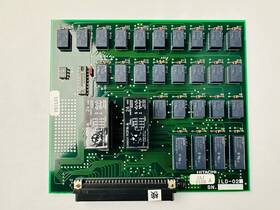
( Brand: Hitachi ), ( Manufacturer Part Number: ILD-02 ), ( Part Type: Board ), ( Unit Type: Unit ), ( Country Of Origin: Japan )
Review HITACHI Interface Board
The **Hitachi ILD-02 Interface Board** is a versatile and high-performance modular interface module designed to seamlessly integrate industrial automation systems with Hitachi s advanced programmable logic controllers (PLCs), such as the ZENON or HIDIC series. Engineered for precision and reliability, this interface board serves as a critical bridge between PLCs and external devices, enabling efficient data acquisition, control, and communication across diverse industrial applications. With its compact yet robust design, the ILD-02 is built to withstand harsh environmental conditions, making it ideal for use in manufacturing plants, process control systems, and automated machinery where dependability is paramount.
At its core, the ILD-02 supports a wide range of digital and analog input/output (I/O) functions, allowing users to connect sensors, actuators, and other peripheral devices with minimal configuration. Its modular architecture accommodates various expansion options, including discrete I/O ports, pulse counters, and high-speed communication interfaces, ensuring compatibility with a broad spectrum of industrial protocols such as Modbus, Profibus, and Ethernet/IP. The board s sophisticated firmware and real-time processing capabilities enable seamless interaction with PLC programs, facilitating complex control logic, monitoring, and diagnostics with exceptional speed and accuracy.
One of the standout features of the Hitachi ILD-02 is its flexibility in addressing both low-level and high-level integration needs. Whether interfacing with simple binary signals or complex analog signals like temperature, pressure, or voltage readings, the board delivers consistent performance with minimal latency. Its built-in isolation protection enhances safety by preventing electrical interference and voltage spikes from damaging sensitive equipment, while its user-friendly configuration tools simplify setup and troubleshooting. Additionally, the ILD-02 supports advanced features such as event-driven triggers, cyclic data polling, and error handling protocols, making it a powerful tool for optimizing automation workflows.
For engineers and technicians working in industries like automotive assembly, chemical processing, or robotics, the Hitachi ILD-02 offers a robust solution for enhancing system efficiency and reducing downtime. Its compatibility with Hitachi s ecosystem of PLCs and human-machine interface (HMI) software further streamlines integration, allowing for centralized control and real-time visualization of operational data. With a focus on durability, scalability, and ease of use, the ILD-02 interface board stands as a dependable asset for modern industrial automation, empowering users to achieve greater precision, reliability, and productivity in their applications.
### Pros and Cons of buying a Hitachi ILD-02 Interface Board
The Hitachi ILD-02 is a legacy industrial interface board designed for connecting Hitachi programmable logic controllers (PLCs) to external devices, such as sensors, actuators, or communication networks. Below is a detailed breakdown of its advantages and disadvantages.
---
### **Pros**
1. **Compatibility with Hitachi PLCs**
The ILD-02 is specifically engineered to work seamlessly with Hitachi PLCs, particularly older models like the HICOM, HIPATH, or HIPATH-Series. It provides direct I/O expansion, allowing users to interface additional digital or analog signals without needing third-party adapters.
2. **Reliability and Durability**
Hitachi industrial products are known for their robustness in harsh environments, such as factories, manufacturing plants, or automation systems. The ILD-02 is built to withstand electrical noise, temperature fluctuations, and mechanical stress, making it suitable for long-term use in industrial settings.
3. **Modular Design**
The board is modular, meaning it can be easily integrated into existing Hitachi PLC systems. It supports various I/O configurations (e.g., digital inputs/outputs, analog inputs, or relay outputs) depending on the specific model variant, allowing users to customize their setup based on requirements.
4. **Backward Compatibility**
For users maintaining older Hitachi PLC systems, the ILD-02 ensures backward compatibility, reducing the need for costly upgrades or replacements. This is particularly valuable in legacy systems where newer alternatives may not be available or may require significant reprogramming.
5. **Support for Hitachi s Proprietary Protocols**
The board supports Hitachi s proprietary communication protocols (e.g., HIPATH, HICOM), which are essential for direct integration with Hitachi PLCs. This avoids the need for additional protocol converters or gateways in some cases.
6. **Cost-Effective for Specific Use Cases**
For applications where only Hitachi PLCs are used, the ILD-02 can be a cost-effective solution compared to purchasing entirely new systems or third-party interface boards that may require additional software or licensing.
7. **Easy Installation and Configuration**
Hitachi provides documentation and tools (e.g., configuration software) to simplify the installation and setup process. The board typically plugs into the PLC s expansion slots, and I/O mapping can be done through the PLC s programming environment.
---
### **Cons**
1. **Legacy Technology**
The ILD-02 is an older product, and Hitachi may no longer support it with updated firmware, drivers, or technical documentation. This can make troubleshooting or finding replacement parts challenging over time.
2. **Limited Availability**
Due to its age, the ILD-02 may be difficult to source from official Hitachi distributors or third-party sellers. Prices for used or refurbished units can be high, and availability may fluctuate.
3. **No Future-Proofing**
Modern industrial automation trends favor open standards (e.g., Ethernet/IP, PROFINET, Modbus TCP) and cloud connectivity. The ILD-02 lacks support for these newer protocols, limiting its use in modernized or IoT-integrated systems.
4. **Dependence on Hitachi Ecosystem**
The board is tightly coupled with Hitachi PLCs. If a user transitions to a different PLC brand (e.g., Siemens, Allen-Bradley), the ILD-02 becomes obsolete, requiring a complete replacement or additional bridging hardware.
5. **Potential for Obsolescence**
Hitachi may discontinue support for the ILD-02 entirely, leaving users without official warranties, software updates, or technical assistance. This risk increases if the PLC system it supports is also phased out.
6. **Limited Analog/Digital Flexibility**
While the ILD-02 offers basic I/O expansion, its analog capabilities (e.g., resolution, range) may be limited compared to modern interface boards. High-precision applications might require additional components or workarounds.
7. **No Built-in Diagnostics**
Older interface boards like the ILD-02 often lack advanced diagnostic features (e.g., real-time error logging, remote monitoring) that are standard in contemporary industrial hardware. This can complicate fault detection and maintenance.
8. **Compatibility Issues with Modern Software**
If the PLC system is updated to newer Hitachi software versions, the ILD-02 may not be fully compatible, leading to compatibility errors or reduced functionality. This can require manual adjustments or workarounds.
---
### **Conclusion**
The Hitachi ILD-02 Interface Board is a practical choice for users maintaining or expanding older Hitachi PLC systems where compatibility and reliability are critical. Its strengths lie in its seamless integration with Hitachi hardware, durability, and modularity, making it ideal for legacy automation setups. However, its limitations such as lack of modern protocol support, potential obsolescence, and limited availability make it less suitable for new installations or systems requiring scalability or future-proofing.
For users with no immediate plans to upgrade their Hitachi PLC infrastructure and who prioritize stability over cutting-edge features, the ILD-02 remains a viable option. Conversely, those investing in long-term automation projects or integrating with newer technologies should consider modern alternatives that support industry-standard protocols and offer better diagnostic and connectivity options.
---
### **Recommendation**
- **Buy the Hitachi ILD-02 if:**- You are maintaining or expanding an existing Hitachi PLC system with no plans to migrate to a different brand.
- Your application does not require advanced communication protocols or high-precision analog I/O.
- You can source the board reliably and are prepared for potential long-term support challenges.
- Cost and compatibility with legacy systems are your top priorities.
- **Avoid or Replace the Hitachi ILD-02 if:**- You are planning to upgrade your PLC system or integrate with modern industrial networks (e.g., Ethernet/IP, OPC UA).
- You need advanced diagnostics, remote monitoring, or cloud connectivity.
- Availability or support for the board is uncertain, and you risk operational disruptions due to obsolescence.
- Your budget allows for investing in newer, more versatile interface boards that support open standards.
For new projects or systems requiring future flexibility, explore modern alternatives such as:- **Ethernet-based interface modules** (e.g., Allen-Bradley Micro850, Siemens ET 200SP).
- **Modbus or PROFINET-compatible boards** that offer broader compatibility.
- **Hitachi s newer I/O expansion modules** (if available) that support updated protocols.
If you must use the ILD-02, ensure you have spare parts, documentation, and a backup plan for potential compatibility issues with future software updates.
Details:
Hitachi ILD-02 Interface Board.
part #: ild02 prices
- $175.00-$250.00
specifications pcbemdev:
- brand: Hitachi
- mpn: Ild-02
- part type: Board
- unit type: Unit
- country of origin: Japan
seller pcbemdev:
- rating: 99.8%
- # reviews: 5327
- city: Richardson, Texas
shipping pcbemdev:
- cost: $11.22
- type: Calculated
- service: FedEx Ground Economy, UPS Ground, FedEx Ground / FedEx Home Delivery
- class: Economy, Standard
- transit: 4-10 Days
- carrier: FedEx, UPS
offer pcbemdev:
- options: Ship-to-home
- availability: In Stock
- quantity: 1
- sold: 0
- best offers: True
- started: February 21, 2026
payments pcbemdev:
- credit card: Mastercard
- wallet: Google-pay
- other
general pcbemdev:
- Electronic Components Semiconductors > Circuit Boards Prototyping > Printed Circuit Boards PCBs
- condition: Used
returns pcbemdev:
- method: Money back
- time: 30 Days
- policy: Returns Accepted
- paid by: Buyer
Hitachi ILD-02 Is Similar To:
- 01-20-00 Hitachi Seiki Cnc Board (51.6% similar) Often these items are priced at only a fraction of their normal cost...(September 1st, 2017)
- 06-19-00-01 Hitachi Seiki Cnc Board (49.2% similar) Often these items are priced at only a fraction of their normal cost...(November 2nd, 2017)
- 0f10383-jpt39c0c9b 0f10383 Hitachi Deskstar 1tb 7200rpm Hdd Pcb Board Only (32.7% similar) Working pull, includes PCB, screws and sticker from associated HDD. Up for bids is a Hitachi 1TB 0F10383 PCB board only...(January 31st, 2016)
- 10-07-04-01b Hitachi Seiki Cnc Board Pzo (45.7% similar) Often these items are priced at only a fraction of their normal cost...(September 19th, 2018)
- 10-08-05-01b Hitachi Seiki Cnc Board (48.5% similar) Often these items are priced at only a fraction of their normal cost...(December 14th, 2017)
- 10-34-03-00 Hitachi Seiki Cnc Board (49.2% similar) Often these items are priced at only a fraction of their normal cost...(July 18th, 2017)
- 10-37-00-01 Hitachi Seiki Cnc Board (49.2% similar) Often these items are priced at only a fraction of their normal cost...(November 7th, 2017)
- 10-43-00-01 Hitachi Seiki Opio-l4 Board (43.5% similar) Help sell shipping-globally. Often these items are priced at only a fraction of their normal cost...(March 31st, 2017)
- 13-19-00-00 Hitachi Seiki Cnc Board Pzj (46.4% similar) Often these items are priced at only a fraction of their normal cost...(September 25th, 2018)
- 13g0208 01 Hitachi Pcb Circuit Hard Drive Controller Board (43.2% similar) Again, your satisfaction is guaranteed. Carefully removed directly from an original unit. Notice sometimes mistakes can occur. PCB board only. Anything not mentioned or pictured is included and does pertain to item...(June 21st, 2018)
- 16-06-02-00 Hitachi Seiki Cnc Board (49.2% similar) Often these items are priced at only a fraction of their normal cost...(September 4th, 2017)