GE FANUC VME-3122A-400000 Analog Digital Converter 16-BIT
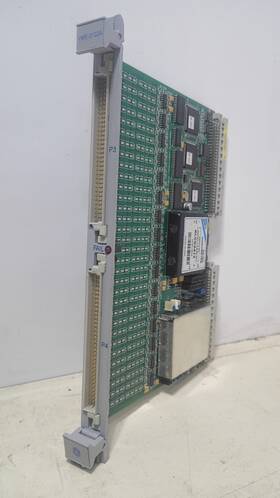
( Brand: Ge Fanuc ), ( Manufacturer Part Number: VME-3122A-400000 ), ( Part Type: Digital Converter ), ( Series: Adc ), ( Country Of Origin: United States )
Review GE FANUC Perfect Condition Vme-3122a 16-bit Analog To Digital Converter
The **GE Fanuc VME-3122A-400000** is a high-performance, 16-bit analog-to-digital converter (ADC) module designed for demanding industrial, scientific, and embedded computing applications within a VMEbus (Versa Module Europa) environment. Engineered for precision and reliability, this module delivers exceptional resolution and speed, making it an ideal choice for data acquisition systems requiring accurate signal processing in real-time. The VME-3122A operates at a remarkable sampling rate of up to **100 kHz per channel** (with a maximum aggregate throughput of **400 kHz** when configured for multi-channel operation), ensuring seamless capture of high-frequency analog signals with minimal latency. Its **16-bit unipolar or bipolar input range** ( 10V, 5V, 2.5V, or 0 10V) provides flexibility for interfacing with a wide variety of sensors and transducers, while its **on-board programmable gain amplifier (PGA)** allows for dynamic scaling of input signals to optimize resolution and dynamic range. The module features **four fully differential input channels**, each equipped with **low-noise, high-precision sample-and-hold circuitry**, which minimizes signal distortion and ensures consistent accuracy across a broad frequency spectrum. Built with **high-speed, pipelined ADC architecture**, the VME-3122A achieves an impressive **16-bit effective number of bits (ENOB)** performance, delivering sub-microvolt-level precision for critical applications such as industrial automation, medical instrumentation, aerospace testing, and scientific research.
Beyond its technical prowess, the VME-3122A is engineered for seamless integration into VMEbus-based systems, offering **backward compatibility** with existing GE Fanuc VME architectures while adhering to **VME64x standards** for enhanced data transfer speeds and expanded addressability. Its **compact, ruggedized design** ensures reliable operation in harsh environments, with features such as **conductive cooling** and **low-power consumption** (typically **
For users requiring advanced functionality, the module supports **software-configurable input ranges, gain settings, and filtering options**, all accessible via a **comprehensive software driver API** compatible with major operating systems and development environments. Its **VMEbus interface** includes **32-bit data transfer capability**, enabling rapid communication with host processors and facilitating high-throughput data acquisition in multi-module configurations. Whether deployed in a standalone system or as part of a larger VMEbus-based data acquisition platform, the GE Fanuc VME-3122A-400000 sets a benchmark for performance, precision, and versatility, making it an indispensable tool for engineers and scientists demanding the highest standards of analog signal conversion.
### **Pros and Cons of buying a GE Fanuc VME-3122A-400000 (16-Bit Analog-Digital Converter)**
#### **Pros**
1. **High Precision and Resolution**
The VME-3122A is a **16-bit ADC**, offering **16,384 discrete levels of resolution**, which is significantly higher than most 12-bit or 14-bit converters. This provides superior accuracy for applications requiring fine granularity in signal measurement, such as industrial automation, scientific research, or high-end data acquisition.
2. **Wide Input Range and Flexibility**
It supports a ** 10V input range**, allowing compatibility with a broad range of sensors and signal conditioning circuits. The ability to configure gain settings (e.g., 5V, 2.5V) further enhances its adaptability to different measurement requirements.
3. **VMEbus Interface for High-Speed Data Acquisition**
As a **VMEbus module**, it integrates seamlessly into **VME-based systems**, enabling high-speed data transfer and parallel processing. This is ideal for real-time applications in **industrial control, aerospace, or military systems** where low latency is critical.
4. **Differential Input Capability**
The module supports **differential input channels**, reducing noise susceptibility and improving signal integrity in noisy environments. This is particularly useful in industrial or laboratory settings where electromagnetic interference (EMI) is a concern.
5. **Rugged and Reliable Design**
GE Fanuc (now part of Emerson) is known for **industrial-grade hardware**, meaning the VME-3122A is built to withstand **harsh environmental conditions** (temperature, vibration, etc.). This makes it suitable for **field deployments** where reliability is non-negotiable.
6. **Backward and Forward Compatibility**
The VME-3122A is designed to work with **VME64 and VMEbus standards**, ensuring long-term compatibility with existing systems. This reduces the risk of obsolescence compared to proprietary or newer interface standards.
7. **Software and Driver Support**
GE Fanuc provides **comprehensive software tools and drivers** for integration with **Windows, Linux, and real-time operating systems (RTOS)**. This simplifies development and reduces time-to-market for custom applications.
8. **Modular and Scalable**
Since it is a **VME module**, it can be combined with other VME-based components (e.g., FPGAs, digital I/O, or timing modules) to build a **customizable data acquisition system**. This modularity allows for system expansion as requirements evolve.
9. **Low Noise Performance**
With **16-bit resolution**, the module achieves **low noise levels**, making it suitable for **high-precision measurements** in fields like **medical imaging, vibration analysis, or power quality monitoring**.
10. **Proven Track Record**
GE Fanuc has a **long history in industrial automation**, and the VME-3122A has been used in **mission-critical applications** for decades. This suggests **reliability and durability** over time.
---
#### **Cons**
1. **High Cost**
The VME-3122A is an **industrial-grade, high-precision ADC**, which means it is **expensive** compared to consumer-grade or lower-resolution alternatives. The price may be a barrier for **small labs, startups, or budget-conscious projects**.
2. **VMEbus Obsolescence Risk**
While VMEbus is still used in **legacy systems**, newer data acquisition systems increasingly favor **PCIe, PXI, or FPGA-based platforms**. This could make the VME-3122A **less future-proof** if migrating to modern architectures is a consideration.
3. **Limited Channel Count (Single Module)**
The VME-3122A is a **single-channel ADC module**. For multi-channel applications, multiple modules would be required, increasing **cost and complexity**. Alternatives like **multi-channel PCIe ADCs** may offer better scalability.
4. **Power and Space Requirements**
VMEbus systems typically require **dedicated chassis and power supplies**, which add to the **footprint and infrastructure costs**. This may not be practical for **portable or compact setups**.
5. **Software and Driver Complexity**
While GE Fanuc provides drivers, integrating a **VME-based system** can be more complex than plug-and-play **USB or PCIe ADCs**. Developers may need **additional expertise** in VME programming or real-time OS support.
6. **No Built-in Triggering or Timing (Requires Additional Modules)**
The VME-3122A does not include **built-in timing or triggering** functionality. For **synchronized multi-channel acquisitions**, additional VME modules (e.g., timing counters) may be needed, adding to the system cost.
7. **Limited Availability of Newer Alternatives**
Modern **FPGA-based ADCs (e.g., Xilinx, Intel Cyclone)** or **high-speed PCIe ADCs (e.g., National Instruments, ADLINK)** offer **better performance-to-cost ratios** in many cases. The VME-3122A may be **overkill** for applications that don t require VME integration.
8. **Maintenance and Spare Parts Challenges**
As VME systems age, **finding spare parts or technical support** may become difficult. GE Fanuc s industrial focus means they may prioritize **new product lines** over legacy support.
9. **No Built-in Digital Filtering or Signal Conditioning**
Unlike some modern ADCs, the VME-3122A does not include **onboard digital filtering or anti-aliasing filters**. Users must implement these externally, adding **design complexity**.
10. **Learning Curve for VME Programming**
If the user is not familiar with **VMEbus programming (e.g., VMEbus standards, memory-mapped I/O)**, there may be a **steep learning curve** compared to simpler interfaces like USB or Ethernet.
---
### **Conclusion**
The **GE Fanuc VME-3122A-400000** is a **high-end, 16-bit ADC** designed for **industrial, scientific, and real-time applications** where **precision, reliability, and VMEbus integration** are critical. It excels in **noisy environments, high-accuracy measurements, and legacy VME-based systems**, making it ideal for **aerospace, defense, or industrial automation** where obsolescence is a concern.
However, its **high cost, VMEbus limitations, and lack of modern scalability** make it **less suitable** for **budget-conscious projects, multi-channel acquisitions, or applications requiring PCIe/FPGA-based solutions**. If **future-proofing, ease of use, or cost efficiency** is a priority, newer alternatives (e.g., **PCIe ADCs, PXI systems, or FPGA-based DAQ**) may be more appropriate.
---
### **Recommendation**
**Buy the VME-3122A if:**- You are **maintaining or expanding an existing VME-based system**.
- Your application requires **16-bit precision in a noisy industrial environment**.
- **Real-time performance and reliability** are non-negotiable (e.g., defense, aerospace, or critical industrial control).
- You have **existing VME infrastructure** and need a **high-accuracy ADC module**.
**Avoid the VME-3122A if:**- You are **starting a new project** and can use **modern interfaces (PCIe, PXI, Ethernet)**.
- Your budget is **limited**, and a **lower-cost 12/14-bit ADC** (e.g., National Instruments, ADLINK) would suffice.
- You need **multi-channel acquisition**, as this would require **multiple modules**, increasing complexity.
- You are **not familiar with VME programming**, as integration may require additional expertise.
**Alternatives to Consider:**- **For modern PCIe/PXI systems:** National Instruments **NI PXIe-6363** (16-bit, multi-channel) or **ADLINK PCIe-9172**.
- **For FPGA-based solutions:** Xilinx **Kintex UltraScale ADC modules** for custom high-speed DAQ.
- **For cost-effective 16-bit:** **National Instruments USB-6363** (if USB is acceptable).
- **For industrial automation:** **ADLINK VME-7880** (if VME is required but with additional features).
If you are **certain about VME integration and need uncompromising precision**, the VME-3122A remains a **strong choice**. Otherwise, evaluating **modern alternatives** may lead to a **more flexible and cost-effective solution**.
Details:
Three scan modes; trigger. Perfect working, extra clean VME Board from GE FANUC, VME-3122A-400000; 33 00B. High-Performance 16-bit Analog-to-Digital Converter ADC.
part #: vme3122a400000 price
- $1575.00
specifications pcbemdev:
- brand: Ge Fanuc
- mpn: Vme-3122a-400000
- part type: Digital Converter
- series: Adc
- country of origin: United States
returns pcbemdev:
- policy: No Returns
shipping pcbemdev:
- cost: $10.50
- class: Standard
- service: USPS Ground AdvantaGe
- carrier: USPS
- transit: 4-10 Days
- type: Fixed
General pcbemdev:
- condition: Used
- Electronic Components Semiconductors > Circuit Boards Prototyping > Printed Circuit Boards PCBs
payments pcbemdev:
- credit card: Diners-club
- wallet: Google-pay
- other
offer pcbemdev:
- quantity: 1
- sold: 0
- started: May 2, 2026
- options: Ship-to-home
- availability: In Stock
seller pcbemdev:
- rating: 100.0%
- city: Lubbock, Texas
- # reviews: 4091
Ge Fanuc VME-3122A-400000 Is Similar To:
- 44a297032-g02 Ge Fanuc Circuit Control Board Arith (33.3% similar) What you see in the pictures is exactly will receive some listings have a single Generic picture if there more than 1 available any questions, just through messaging and we respond as soon can...(January 26th, 2019)
- 44a297034-g03 Ge Fanuc Circuit Control Board (33.3% similar) What you see in the pictures is exactly will receive some listings have a single Generic picture if there more than 1 available any questions, just through messaging and we respond as soon can...(January 26th, 2019)
- 44a399746-g01 44b399267-001 44a399746-g01 Ge Fanuc Pc (15.6% similar) Ge Fanuc 44A399746-G01 PC board 44B399267-001 location: unit 2 shelf 5 box...(August 13th, 2017)
- 44a717559-g01 Hlip1 44a719254-001 Fanuc Used Ge Circuit Board (25.2% similar) Shelving number O80...(March 6th, 2019)
- 44a719326-g01 Ge Fanuc Board Module Used (20.3% similar) Used, in great condition 092318V4...(September 23rd, 2018)
- 44b398625-001 44a398714-g01 44b398808-002-8 44b398625-001 44a398714-g01 44b398808-002-8 Ge Fanuc (8.7% similar) On able to functionally test sold as is for parts rebuild...(February 16th, 2018)
- 44b398806-002-4 44a398712-g01 44b398623-001 44b398806-002-4 44a398712-g01 Ge Fanuc (9.4% similar) Unable to functionally test sold as is for parts or rebuild...(February 16th, 2018)
- 44b399272-001 Ps112 44a399751-g01 44b399861-002 Ge Fanuc (11% similar) Unable to functionally test sold as is for parts or rebuild...(March 1st, 2018)
- A03b-0807-c051 Ge Fanuc Input Module Used (24.8% similar) Fanuc AAD04A A03B-0807-C051 input module used this item is and in working condition...(November 6th, 2018)
- A06b-6100-h001 Fanuc Rebuilt Ge Servo Amplifier (23.7% similar) Once we Get the return, will inspect item to make sure it is in same condition as shipped...(January 11th, 2019)
- A16b-1000-0030-06c Ge Fanuc Circuit Board Rack Backplane (25% similar) Ge Fanuc A16B 06C circuit board rack back plane...(September 20th, 2018)